Selected from the Spanish by Ikaro Valderrama Ortiz
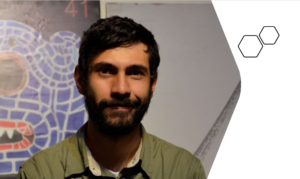 Juan Daniel Neira Basto (Bogota, 1992) is a professional in Literary Studies from the Pontificia Universidad Javeriana. Teacher, poet, musician, and theater actor. In 2017, he published his first book of poems, The Faces Behind the Flame. In 2020, he was selected to participate in the poetry festivals Gestos de la Poesía (Universidad de los Andes, Bogotá) and Encuentro Poético del Sur in Caracas, Venezuela; and in 2021 he was selected by call to participate in the 31st Medellín International Poetry Festival.
Juan Daniel Neira: A Breathing Word – Francia Elena Goenaga
(Poems translated by author)
Juan Daniel Neira’s poetry is a dialogue between a “you” and an “I” that frequently switch places in the interlocution; the “I” is “you” and the “you” is “I.” In this exchanging of places, the word is the bridge. The poetic word is breath, peace, the ability to name, death and resurrection, a loving word like a “garden in bloom.” But it is also silence and emptiness. The “you” has a face that blurs behind the flames, behind water and wind, and it appears to belong to the order of the unknown. In other occasions, on the contrary, it shows itself clearly in a memory made of words:
The flame is an abyss,
a circle without figure,
a spring
and a black hole,
a breathing word.
Gastón Bachelard’s presence stays from beginning to end in Neira’s collection of poems. The candle and the flame speak to us of the presences and absences that go from one state to the other in the dissolution of the contraries. It is not clear if it is dealing with divinity, because the figure of the beloved adopts different forms. Maybe, it is the creative capacity of love what prevails.
When the candle dies
it’s fire’s reborn
in the wick
of another kingdom.
Life’s tenderness
when death’s tenderness
and they both blur
in that delicacy.
The greatest delicacy is that of the poem:
Love and emptiness
are in God
a same song.
A solitude that celebrates itself
by being the voice of fire.
__
From the book The Faces Behind the Flame (2017)
Not a single face,
only the flame,
only the mirror.
The void
disguises me
with Creation.
__
Heart of the bonfire,
home of multitudes.
The even beating
of a shapeless truth,
a fate accomplished
in the presence of a flame.
__
I swim upriver
through the eyes of the candle.
I’m again sitting
in the heart of the spring.
__
The flame is an abyss,
a circle without figure,
a spring
and a black hole,
a breathing word.
__
Flame,
translucent verb,
feast,
health,
and poetry.
Death,
void,
solitude.
__
The greatest veil has fallen.
To love
is to contemplate your face.
To love is to disappear
in the presence of your love.
__
Time has insisted
in holding you as a beacon.
I owe you the fall
of my gods and my temples.
After every fire
only your naked altar
has remained.
__
Day after day
you level the road,
you open the dusty eyes
to return its sight to the bird.
Through the darkness of your eyelids
enters a light that refuses to perish,
these dreams resist
that I submit to fear.
__
Maybe I’ll forget
the hallways in my house,
the shape of a pair of lips,
or the sound of running water.
There’s no guarantee
I’ve learned
from the commerce with my shadows.
But you, amongst the flames,
are every memory, the sea,
the time within the stars.
__
GESTURES OF THE LATIN AMERICAN POETRY is a selection of Latin American authors published as part of the transmedia digital project Gestos de la Poesía, held by the Cultural Center of the Universidad de los Andes, Bogotá, Colombia, since 2020.
Editorial Committee of Gestos de la Poesía in Bogotá includes Ximena Guerrero (Head of the Cultural Center, Universidad de los Andes), Francia Elena Goenaga (poet and professor of literature at the Universidad de los Andes) and Íkaro Valderrama (Colombian poet and singer-songwriter).
Website: https://live.eventtia.com/es/gestosdelapoesia/Gestos-2020