A BOOK REVIEW BY DIPANWITA BHATTACHARYYA
“Isn’t it possible that all of us are actually ghosts, and we’ve simply taken on human form?”
The unabashed representation of life in Bangladesh reflects on the realities at the peripheries of society and how these lives are affected by the political circumstances of the country. Azizul Huq’s writings pay minute attention to partition and the crisis of the post independent nation. His artful prose is steeped in a daring political consciousness. The stories lay bare the sufferings, sorrows, angst and frustrations of the oppressed and raise disconcerting questions to understand what it truly means to be human.
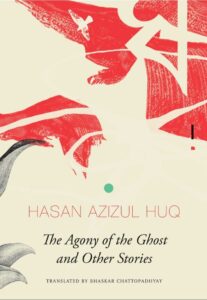
The Agony of the Ghost and Other Stories presents a collection of twelve short stories by the eminent Bangladeshi novelist and short story writer Hasan Azizul Huq. Translated from Bengali into English by Bhaskar Chattopadhyay. The collection includes one of the most well-known stories by Huq such as The Vulture, Without Name or Lineage and others. And by means of the skillful translation, the stories remain rooted to the place and the people while conferring their stories to the English readers.
In the following, I would like to briefly discuss about certain stories in the collection to illustrate the tone and tenor of the book.
The very first story – where the book begins- opens at the Emergency of a Hospital. The reader is immediately faced with the horrid descriptions of pain, suffering and images of death. And as the story gradually unfolds, the condition of the hospital becomes a metaphor for the political and economic situation of the country. The money grubbing and self-serving doctors become an image of the people in power. The apathy of the hospital workers, their complaints about low wages and rising prices of rice, convey the economic circumstances of the different strata and their distrust of the government, who is referred to as being “constipated”. These images are not unknown in our own times. By articulating the hopelessness of the poor, Azizul Huq reveals the inequality in distribution of resources and selfish motives of the privileged that imprison everyone in an unjust system. And so it is in the same story that the urge for a revolution is raised, in what is one of the most riveting conversations in the book. The gory details of the hospital reveal the deep-seated injustice inflicted on the less privileged and inspires the need for fundamental change.
Azizul Huq’s writings also delve into the personal sphere of life, and how it is affected by the larger political scenario. As, The Cage, an intimate story about a family becomes a microcosm of the pain inflicted by the Bengal partition. Set during one of the most significant migrations in the history of the subcontinent, the story captures the moment of transition into a new order by shifting away from the traditional way of life. When the father asks his son, “If only I could help you somehow, even if that means having to die” is an unthinkable tragedy of economic and personal suffering. Such instances evoke the writings of Premchand and other contemporaries, reminding one of the shared histories of the broken land.
The stories further reflect on the inner state of mind of an individual. Like, in Throughout the Afternoon, we find a young boy trying to cope with the impending death of his grandfather. As a 12-year-old boy comes face to face with death. The story articulates the concerns of the young boy as he broods over his game of marbles and about school, while he also shares his concerns about his family – as he anticipates his father’s return. When he is found talking to a tree about his grandfather, he indeed engages in a conversation with himself. The story thus preserves the fleeting winter afternoon.
On that winter afternoon, all of Nature grieved. Nature, in this way becomes a part of the flow of life and forms a part of the storyscape. Azizul Huq’s writing comes alive in the vivid imagery and descriptions of sound and smell. As every scene is painted masterfully and the correspondence of the sensory associations immerse the reader in the story. The Cage begins with the sound of dewdrops and sitar. Similarly, the use of contrasting images, such as the image of a cool room with a sweet smell juxtaposed with the crow sitting outside with a dead rat – makes the stories unexpectedly realistic. This is also evident in the piercing descriptions and idioms.
The interrelation between man and Nature reaches a climax in one of Huq’s most renowned stories – The Vulture. Where a group of young boys try to chase and capture the bird. The vulture usually associated with death and destruction and everything that is against life is completely helpless here. It is pertinent perhaps because when faced with the vulture, man is reduced to his mere flesh. Yet the vulture does not eat another vulture. Are humans any better?
Likewise, Azizul Huq’s stories often do not end with the resolution of the plot but posit several unnerving questions. The ambiguous endings moreover demand the readers’ active engagement with the story.
The Agony of The Ghost exemplifies the unfinished story. With its unique perspective of narration, the story deals with the life of a ghost after death. In Bengali, the word for ghost can also mean the past, so our protagonist is not simply a ghost but “he was the past”. And as a ghost he is cursed to eternal hunger as a burden from his mortal life. The ghost on neem tree is also a popular figure in Bengali popular literature and folklore. Ghosts who prey on young children and devoured humans, they are seen gushing over the smell of human flesh. But by presenting the agony of the ghost, the dangerous creature is imagined as eternally suffering and without ways to fulfill his hunger. And again, through this story of a ghost, Azizul Huq questions the inherent inequalities and injustice among men where many are denied the fundamental necessities of life.
The history of Partition and the consequent migration is part of the very recent history of the Indian subcontinent and continues to affect the lives of people on both sides of the border. And the image of contemporary society so brazenly represented by Azizul Huq instigates the necessity to address the structures that mould our society and our lives. And let us ponder on the many questions that the stories leave behind.
Also, read The Second Taj Mahal by Nasera Sharma, translated from The Hindi by Ayushee Arora and Published in The Antonym:
Follow The Antonym’s Facebook page and Instagram account for more content and exciting updates.