Translated from the Hindi by Varsha Tiwary
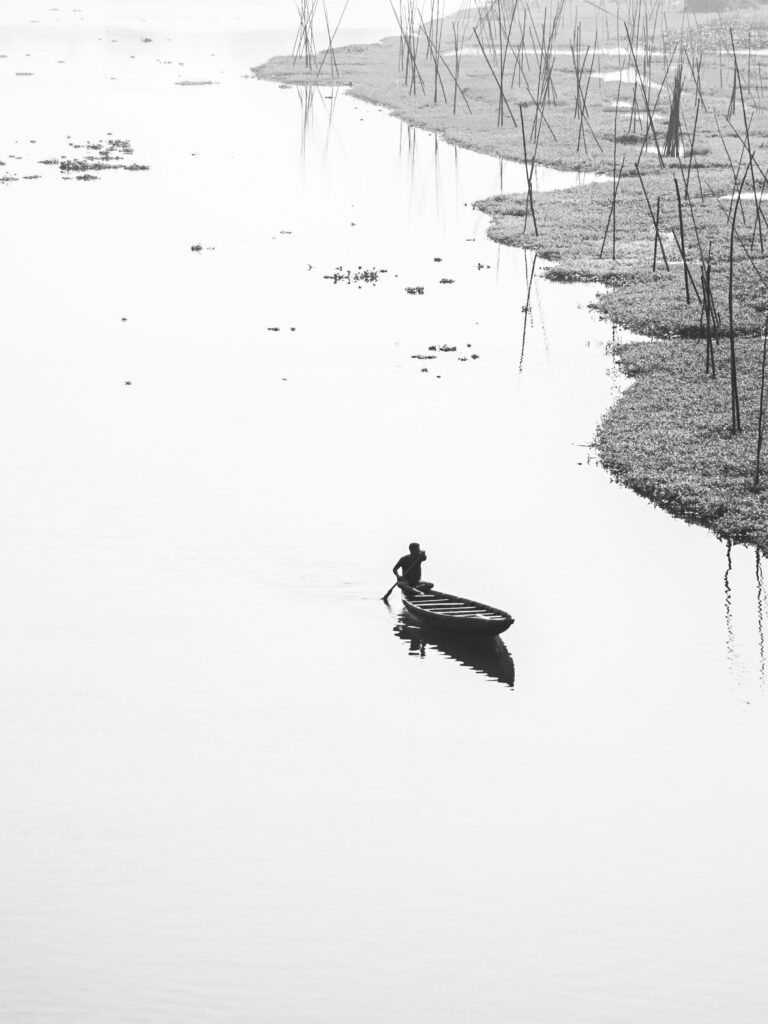
Mother would tell us that we hailed from Sonardeeghi village, in Faridpur, now in Pakistan. Even after Bangladesh came into being in 1971, she continued calling it Pakistan. Many Bengalis hailing from that side would keep the two Bengals together in their hearts with the phrase: thisside Bangla, thatside Bangla. Only our mother could not. Who knew what complex lay behind it? It was not that she had shut her door and windows on everything from that side. Even after coming over to this side, for a long time her roots would ache for water and soil from that side. Those rippling paddy fields, the tall and lofty coconuts, the flavorsome mangoes and jamuns, the vast-wide rivers surging with waves, the boats bobbing on the water’s cradle, the strains of Bhatiyali songs drifting from the boats at night. O my heart’s boatman, take away these oars/ I can row no more/ I’ve rowed and rowed my life away/ Nowhere is the shore… The splish-splashing water clapping beat to the plaintive notes stretching all the way to the horizon!
Mother would tell us about the tongas—raised platforms on stilts—on which whole families would wait for the tidal waters to recede. Besides mangoes and jamun, she would yearn for the flavour of the kamla lebu sweet limes of Sylhet. As far as she was concerned, Nagpur and Darjeeling oranges were not a patch on them. Leave fish, she could turn any stem, flower, root, kacchu daanta, mochai, ole—taro stem, banana flowers, yam— into such delectable curries that we couldn’t stop exclaiming, ‘Mother, where did you learn to make such excellent curries?’
‘Over there. They say, if a woman from that side were to cook the sole of a shoe, that too will turn out so delectable that folks would go on licking fingers.’
‘When everything was so good there, why did you leave?’ We would ask.
This question would make our mother go quiet every time.
I had never been to Sonardeeghi before, but mother spoke of it so often that a Sonardeeghi was installed in some innermost corner of my heart where I could shift the coconut and betelnut trees at will. Sometimes this side, sometimes that. By the riverside, or away from it. At times, I would make the whole ambience teem with the big-leaved kacchu. At others, with only mango and jamun trees. Today, while coming to Sonardeeghi, my imaginary landscape kept getting ruffled time and again. The river was there, the trees and leaves too. But with a slight difference. The men wore lungis. Not one dhoti was to be seen. The women, though, wore sarees. That school was still there but it was a pucca construction now—mother must have learned the alphabet there. Or could there have been another school back then? But voicing such ifs and buts wouldn’t go down well.
In 1947, during partition, only Nani, Nana, and my mother managed to cross the border. My middle aunt was kidnapped by the rioters. One maternal uncle got killed. The eldest uncle and the youngest aunt somehow managed to save themselves and had to turn back towards Sonardeeghi. When the situation improved, my youngest aunt came over to India to meet us. By then we had settled in Bardhhaman. I was born after Bangladesh was formed. I was just five when I first saw Anima Di, my youngest aunt’s seven-year-old daughter. Today, no one except Anima Di is left from my aunt’s family. Anima Di has come back from her in-law’s place and now lives in Sonardeeghi. This was all I could glean from the letters. All this is from ten years ago. Even the link of letters had been snapped years ago.
Who knows how many Hindus are left here now? I had heard that after the demolition of Babri Masjid many temples were destroyed here. Till now I haven’t come across a single temple. Fundamentalism is back in Khaleda Ziya’s rule. How must Anima Di be coping with all this?
How ironic that in West Bengal, the Ghotis call those of us from the East, ‘Bangal.’ In every Mohun Bagan versus East Bengal football match, this Ghoti-Bati—the pot versus the bowl—West-East dichotomy gets fully precipitated. The Ghotis cast doubt on our very caste.
And here, poor Anima Di lives like an exile in her own homeland. In the very place she was born, she is marked as an outsider by her religion and caste. For us, the tiniest of taunts are unbearable. The minute someone calls us Bangal, we go up in a tizzy. How must Didi be coping with taunts round the clock?
I knew one Zainul, labelled a Muhajir, as his father had migrated from Bihar to Bangladesh—it was called East Pakistan at that time. After Mukti Sangram, he had to flee to West Pakistan. His loyalty was questioned in India, then in Bangladesh and in Pakistan as well! He had thought that religion would provide a secure armour—a reliable, durable identity. But things did not turn out that way. Human issues are now decided by political and religious powers. It’s they who dictate what our fates would be… They don’t even ask us. Ethiopia, Turkey, Somalia, the Middle East, the Caribbean. Where is it not so? Even here it’s the same. Sociologists term all this ‘normal.’ An internal flux and flow routine in the life of civilizations and cultures. As for stories of the wreckage wrought by such population displacements, who wants to hear them? When a thing breaks, so many splinters are left behind. And what is added? A new chapter. Springing up from the old, scarred node! Oh! Why did this wretched Zainul come to my mind at this very moment! I was on the rickshaw, and Suhel, the police constable accompanying me, was pedaling the bicycle. As soon as we entered the village, we saw a group of people gathered in a tea hut adda.
I asked, ‘Dada, where does Nihar Singh live in this village?’
By way of reply, many questioning looks were directed at me. Had I erred? On my part, I had been fully alert. I was in a saree, not jeans. Even my language… Oh no! I’d indeed blundered. My pronunciation of ‘this’ was incorrect. I should have said haie, not aye. I was mortified. But what had to happen had happened. The adda folks whispered amongst themselves, then a darkish, middle-aged man spoke. ‘What name did you say, Nihar Singh?’
‘Ji, yes.’
‘We know no one by the name Nihar Singh.’
‘All the Singhs (lions) ran away.’ The pun in their collective laughter drenched me in acid.
‘Where is your house?’
My treacherous tongue could not be trusted, so setting the local dialect aside, I switched to standard Bangla. I told them, ‘I’ve come from Bardhhaman, West Bengal. During Partition, our ancestors had gone from here. Back then, there used to be one Ujjwal Singh. I am his granddaughter. Nihar Singh was my aunt’s daughter’s husband—that is, my brother-in-law. And Anima Di, is my cousin sister. I was visiting this side, so I thought, let me see the ancestral house and meet my family members.’
Now other villagers started assembling. They were talking amongst themselves and staring at me. In their eyes, I was either dubious, or unauthorized.
A middle-aged man called out to a teenager, ‘Tahir, just take her to Salahuddin Sheikh’s house.’
Salahuddin Sheikh? What nonsense was that. A terrible fear jabbed my ribs.
A medieval bullock cart tented over with bamboo matting to protect from rain, was trundling up the unpaved road. Some boys were playing cricket. In the distance, I saw houses with thatched roofs; at times, a house with two levels, or with a tin roof. Banana stem pillars everywhere, some bamboo thickets, coconut trees on both sides of the road, some intact, others broken or dead, perhaps due to repeated cyclones. Fields rippling with the season’s grain. Ridge gourds and other vegetables growing in between. The constable from the thana dragged the bicycle along as he talked to Tahir. At times their words went over my head. All I could gather was that he had come here to find work for wage. Today he couldn’t find work, so he was jobless. He had no idea when he would find work. Or who his parents were, where he hailed from.
I had been told about Bangladesh’s orphans—thousands of them—in Dacca and other cities. Most were born of rapes perpetrated by the opponent armies during the Bangladesh war. No one adopted these luckless ones. They came of age, growing up anyhow on their own. Then they produced children of their own. Yet another crop of castaways living in extreme poverty, and on top of it, inflation. This cuscuta creeper had now proliferated all the way to Delhi and to Mumbai. From there to Dubai and London.
Waving a hand at me, the constable whispered something to Tahir. Diffidently, Tahir started walking next to me. ‘Didi take me along, I can do any kind of work.’
‘But how can I take you along?’
‘Why? Haven’t you come to take Salahuddin’s sons? I’m poorer. They have parents and land. A boat as well. I have nothing.’
Dumbfounded, I asked, ‘Who told you that I have come to fetch Salahuddin or anyone’s children? I don’t even know them. I have come to find Nihar Singh, who is my cousin sister’s husband and my brother-in-law.’
‘Oh!’ Tahir’s face fell. Then he said, ‘But I have been here for six months. There is no Hindu family here. By the name of Nihar Singh or anyone else. But you can look around yourself and inquire. Maybe you will find something. Here is the Basti.’
I looked at every house. This must be the house. No that. Tahir had already moved ahead. Maybe the house was ahead… Mother would mention the river and how the water rose under during high tide as they sat on the platform-on-stilts. But there was no raised platform here. Or even a glimpse of the river. Tahir stopped outside a house. The constable parked his bicycle. ‘This is the house.’
A verandah with a straw roof. A goat tethered in one corner, a cow in another. Hens followed by cheeping little chicks sauntering in the front yard. Children in skull caps leaving for the madrasa. A typical Muslim household.
The constable called out. ‘Where is Sheikh Moshay? Look! Someone has come to meet you.’ A woman came out of the house. Many other women also came out from nearby houses. Some men as well. All of them stared wide-eyed at me.
‘Salahuddin has gone to Dacca. His wife is here.’ A woman said.
‘Please inform her.’ Constable Suhel told them.
‘I see a new face.’ Shielding her eyes with a hand, an old woman peered into my face. I felt abashed.
‘She is a Hindu press reporter. She has come from Bardhhaman.’ Said the constable.
‘Here…?’
‘She has come looking for her brother-in-law, Nihar Singh. She says her ancestors were from this village.’
The old lady’s face turned serious. ‘Do you have the police station’s permission?’
‘Yes, that’s why I’ve come along.’
‘Boodi, O Anjuman Boodi, see who has come to meet you from Bharat.’
Anjuman Boodi. I slowly chewed on the phrase. I recalled that even when she had come to Bardhhaman, Anima Di’s calling name was Boodi. So, had Anima become Anjuman, and Nihar, Salahuddin? A woman ran on swift feet and froze in the doorway, as if the flow of her joy was reined in by amazement. Yes, she had the same wheatish complexion and the round face, studded with the same big, tawny eyes.
I could no longer hold myself back. I took her in a crushing embrace. ‘Didi, Didi, my Didi. I am seeing you, my Anima Di, after so long. Do you recognize me? I am your Shikha—Guddi.’
‘Leave me. I don’t know any Shikha or Guddi.’
Deeply dismayed, my grip loosened. Was I clutching some corpse, then? Many women had assembled. The situation was getting ridiculous. I started justifying myself. ‘Do you remember Didi? I was this big when you came to Bardhhaman.’ With my hands, I indicated a five-year-old child. ‘I was five, you, seven. You would hoist me up and carry me around. You couldn’t even carry me properly. Once, you fell down with me in the arms and got thrashed as a result. See this scar above my brow.’
Dazed, Anima Di kept staring at me.
‘You had invited me over time and again; meet me once before I die. Do you remember? Once, while we were playing, you’d said that for my wedding you would give me dangling jhumkis.’
Anima di kept standing, expressionless as a wooden doll. I had no idea what to do. What a spectacle I had turned myself into. A cold current of shame and humiliation coursed through my veins. Today, when, after covering so much distance and crossing so many hurdles, destiny had finally brought me to her, what if she refused to speak? When would we talk then?
The bored constable asked, ‘How much more time would it take?’
‘Leave it! When she herself cannot recall anything, what more will you ask?’ Said the middle-aged woman who had spoken earlier. ‘What’s gone is gone. Yes! But when you have come all the way to your maternal village, you must at least put a couple of morsels of rice and fish in your belly.’
‘But Mausi, I am…’
‘No ifs and buts. Unless you have any religious hangups about eating food touched by a Musalmaan.’
‘No Mausi, there’s nothing like that. But I wanted to take a bath. My body is sticky with sweat.’
‘What’s the big deal in that, the river is right next to us. All the girls are going. You also take a dip or two. Anjuman Boodi, take her along. But be alert. One can never trust the high tide.’
There were around ten young women and girls in that group and not a single old woman. So, we chatted easily.
‘Accha Didi, how far is Kolkata from your Bardhhaman?’ One inquired.
‘It takes one and a half hours by train.’
‘It’s a huge city, isn’t it? And does the train run underground?’
‘Yes.’
‘Have you ever traveled in it?’
‘Yes. Many times.’
‘That must be fun, no?’
‘Yes.’
‘Where is Ayodhya?’ The question came from a short, serious-looking girl.
‘It takes fifteen hours from our place.’
Thankfully, she did not ask anything beyond this. Without actually touching, she had pointed at the point of fear and hate.
‘You must be boarding an aircraft as well?’ The third question.
‘Yes.’
‘Can Muslims also fly?”
‘Why not?’
‘Achha, don’t they have Robi Thakur’s Shantiniketan there—where girls and boys can fall in love?’
‘Why? Has anyone stopped Ganga-Padma shore dwellers from falling in love?’
All the girls burst out in laughter. I looked sideways at Anima Di, walking aloof, lost in herself. Her face never thawed into a smile.
‘Didi, what sort of a reporter are you? Had you brought your camera along, all of us could have clicked a picture together.’
‘Indeed, I goofed up.’ I bluffed. How could I tell them that I had to surrender my mobile, camera, and tape recorder—all three—at the police station?
We were outside the village now. I was looking back time and again.
‘What are you looking for, Didi?’
‘My mother had told me that there was a platform on stilts in a pond behind our house, and our whole family would sit on it during high tide. At night, the reddish light thrown by boat lanterns would gleam playfully on the waves. The village was thick with mango, jamun, coconut trees, and the ground underneath, with kacchu leaves.
‘Since then, countless floods and cyclones have come. Who knows how many times Sonardeeghi was obliterated and resettled?’
The young woman was right. When my own cannot recognize me, all else, the entire wreckage wrought by history and geography, must also be gone. But how to cure my nostalgia?
Green fields stretched beneath a hillock, and beyond it lay the river. I drank in everything, drop by drop.
‘You have nothing to change into!’ A young woman suddenly remembered.
‘What about all of you?’
‘What of us? We will wear a gamocha or go in just like that.’
‘I don’t even have a gamocha.’
‘I will pull one off someone.’
The girls broke into giggles. A smile surfaced on Anima Di’s face for a brief moment, then disappeared.
Bits of mica and shells, flashing blue, glittered in sand. May be, the bones of my ancestors were mingled in them. Maybe this blue was their phosphorous burning across the shore of times gone by!
‘Hurry up, Didi. We must turn back before high tide,’ cried a short young girl as she slipped into the river. Anima Di went on scrubbing her heels on the ghat steps as if in no great rush.
Before us, the river stretched, wide as the ocean. Here and there, boats bobbing. A steamer or two as well. Splish-splash-splish, the silt-laden water was keeping beat, but no Bhatiyali songs streamed. Only a timid little sound rose up time and again. Was it real, or my imagination? Or was it just the sound of the pain in my heart, leaping out?
No. Not at all. On the shore, a gharial had seized a goat, and the timorous sound was the goat’s bleating. The girls all ran in that direction, their feet splashing the water. Only me and Anima Di were left. Still lost in herself, Anima Di slowly lowered down into the water. As if one ocean was slipping into another. This was my chance. When she surfaced after a dunking, I gripped her with my arms, ‘Who are you fooling Didi, me, or yourself?’
Her body trembled, then became steady. ‘Leave me. Let’s not be heedless in the river.’
‘No. I won’t let go. First tell me the truth. Swear on my head and if you lie, may I die in this very river.’
Didi’s eyes brimmed over. ‘I remember. I remember it all, Guddi. What do you know of what all we had to face! The bleating of the goat caught in the gharial’s jaws can be heard by everyone, but our cries?’ Didi stopped for a moment, gathering herself, then said, ‘Should we have saved our lives or our religion? We chose our lives. For how long could we fight? With how many could we fight? Now we are different and so are you. We are Muslim, you, Hindu. We are Pakistan. You are Hindustan.’
What amazed me was that my maternal aunt’s daughter, Anima, who had turned into Anjuman, was also calling Bangladesh, Pakistan. Just like my mother.
‘Didi.’ Many questions rose and roiled my mind, but Anima Di put a finger on my lips. ‘No. Don’t ask anything. Ask nothing. For God’s sake, don’t ever mention this to anyone. Go back and never come back. It’s been so hard to control myself Guddi.’
‘All right Didi, I’ll do as you say. I will go back and never disturb you ever again. Like tears I am not shedding, I will drink everything up. But for once, just once, hold me to your breast, hug me tight and kiss me hard. With all your body, breath, soul. Don’t be afraid. This wall of water will screen us. No one except God is watching us.’
‘Don’t insist dear sister, my lovely Guddi. If we do that, we will drown.’
‘Let’s drown then. Let this moment be the first and our last as well.’
Locked in embrace, the two of us embraced and rocked on the water’s cradle. It was an amazingly joyous occasion. The ambience grew luxuriant with mango, jamun, and coconut trees. The canopied trees above, the vivid greenery of kacchu leaves underneath. Happy were the gods, the earth queenly. A faint faraway tune rang in our ears, a Bhatiyali song floating in from some unknown land beyond sorrow and joy. Two droplets shimmied on the broad disc of a kacchu leaf. Like two bits of diamond. Shimmying, they became one.
Photo by Shakib Uzzaman on Unsplash.