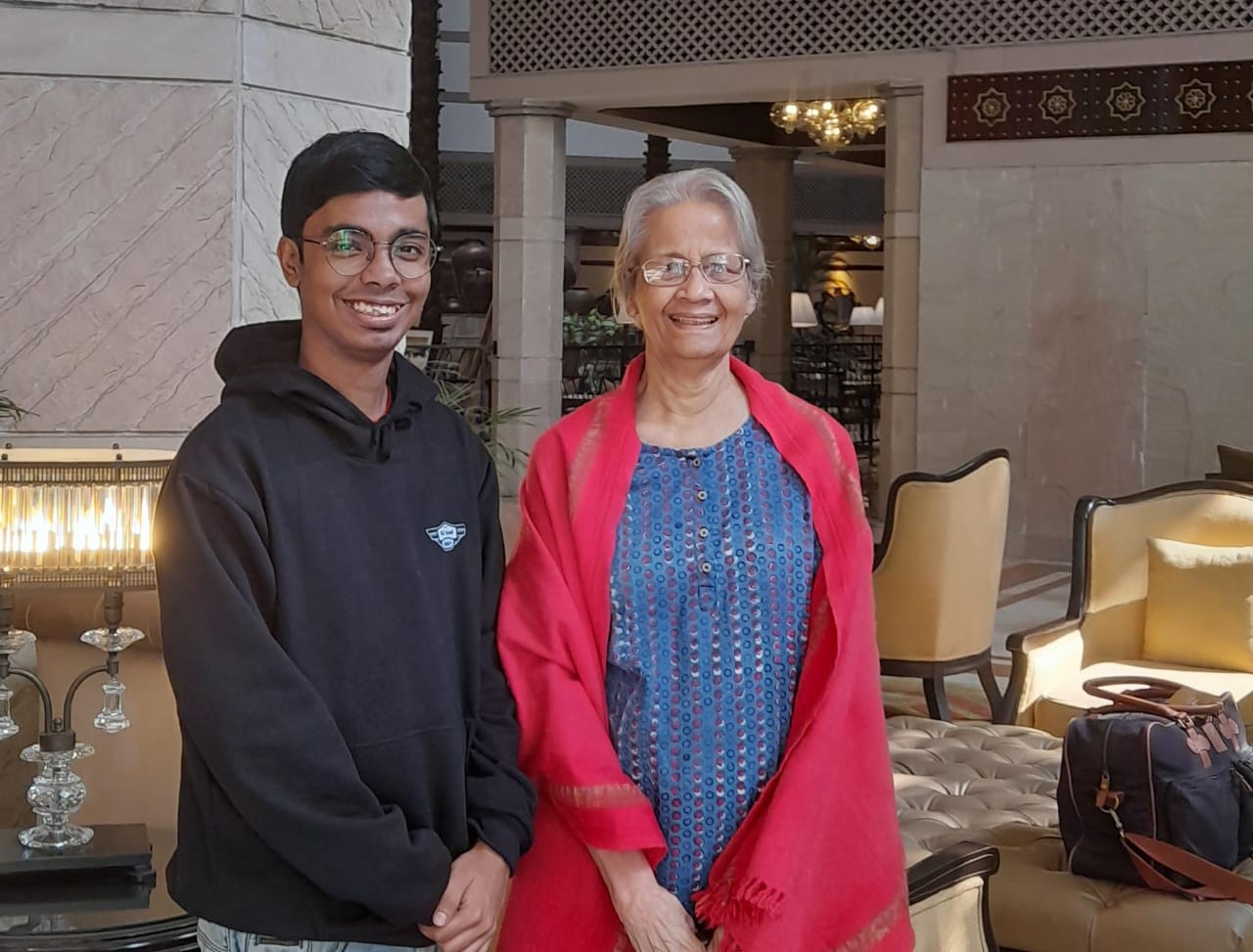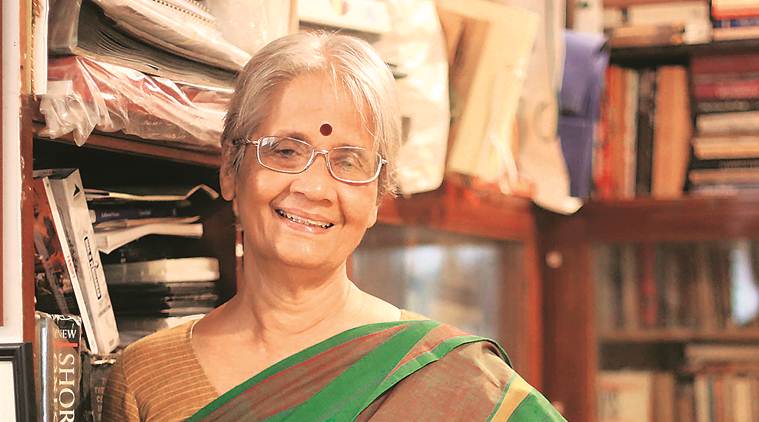
INTERVIEW WITH SHANTA GOKHALE BY OWSHNIK GHOSH
Shanta Gokhale is an Indian writer, translator, journalist and theatre critic. Shanta Gokhale has previously worked as a part-time teacher and as a public relations executive. Gokhale initially published stories, in both English and Marathi, in various publications, and eventually in the 1970s, she started publishing novels. She has written screenplays for several films and documentaries. Gokhale has formerly been Arts Editor with The Times of India, Mumbai, and Sub-Editor at Femina. She has previously been a columnist for newspapers like The Sunday Times of India and The Independent, for tabloids like Mid-Day and Mumbai Mirror and for websites like Scroll.in. As a translator she has worked on veteran actress Durga Khote‘s noted autobiography and has published translations of several plays by leading Marathi playwrights like Mahesh Elkunchwar, Vijay Tendulkar, G.P. Deshpande, and Satish Alekar.
Owshnik Ghosh: How were your early days with literature before you started writing?
Shanta Gokhale: I think, because I did my B.A in Literature, I was always interested in reading voraciously. So, when it came to the point of choosing a major subject, I chose English Literature. I was in London, I did my advanced level there, and then got a seat at Bristol University. So, I graduated in English Literature. Writing had always been a kind of hobby for me. Like a lot of young people, I also had a private notebook in which I used to write. It never struck me that I would actually become a professional writer. It just so happened when one of my pieces got published in The Times of India. And, suddenly I thought–you know, there’s always a moment at which you realize–that what you write for yourself appears to be important to other people too. And that happens when someone wants to publish what you have written. That moment for me, became a kind of a push towards the possibility that I could write professionally. And so, what had been a private hobby became a professional work.
OG: Who were the Indian writers you were reading at that time?
SG: I wouldn’t say Indian–I would say Marathi writers. Because Indian writers at that time–I didn’t really care to read in English. I think I am probably one of the few people who hadn’t read Mulk Raj Anand, who hadn’t read R.K Narayan, who hadn’t read Anita Desai. I was much more interested in reading the English, the French and the Russian writers, the German writers–translated, of course, into English. So, that was that part of my reading. And the language part was Marathi. A whole new kind of short story, and a new kind of poetry, was being written around the 1960s. It was a general Indian movement because it was happening next door to Maharashtra, in Karnataka as well. They called it the Navya Movement. And with us, it was Navakatha, and Navakavya. So, those were the people I was reading. It was with reading short stories that I was, I think, coming to grips with reality. Realistic short stories – raw, you know? In poetry, it was actually a return to Tukaram. Many of the new poets saw their ancestry in Tukaram. Otherwise, they were experimenting with form. These were the two kinds of writers that I was reading.
OG: Did your work as a journalist complement your literary endeavours?
SG: Actually, I began writing as a journalist. That was my entry into writing. There were a lot of magazines then, especially women’s magazine. There was a magazine called Imprint, which Ruskin Bond used to head. So, these were the magazines I was writing for. And the Sunday newspaper features too. It wasn’t as much of creative writing as it was feature writing. Then, somehow, the demands came from the magazines for short stories–they would have special issues, fiction issue. The general idea was that anyone whose writing features could also write a short story. So, I was asked for one – I think Eve’s Weekly first asked me for short stories. Yeah, well . . . I had short stories in my mind. (Laughs) I just wasn’t writing them. So, when these requests came, I wrote–I never really wrote short stories out of my own impulse. Most of my short stories, then, were written on request, and somehow, when a request came–I had a short story to tell. (laughs) So, I realised that yes, there is a fiction writer in me, but I wasn’t ready to explore it just then. You require a lot of confidence to do that, because then, you are on your own. Here, you are writing a feature because the editor has asked for it and you know that it will be published. So, it took me a really long time to trust myself enough to stick out my neck and start writing fiction.
OG: How was your first Marathi novel born?
SG: See, as I was saying in my session yesterday, it is written from the point of view of the so-called Other Woman. And, it was actually born out of what I was seeing around me at that time. A friend of mine was having an affair with a married man. I was working in Glaxo laboratories, in the Public Relations Department, at that time. There was a young executive woman who was also having a relationship with her boss. Then, there was a third person in my family who was having a relationship with a married man. I thought now that women are stepping out, and they are doing these kinds of jobs with responsibility–the independent women, there are these men for whom a relationship is not a threatening thing socially. For a woman, it is, not for a man. And of the friends who kept talking to me about the relationship. And I often said to her, “You know, I hope you don’t think that this man is going to marry you. Its okay if you are going in with open eyes. But, I don’t see this ending in marriage.” But, she was very hopeful because the man kep[t saying, “I am going to divorce my wife, I am going to divorce my wife,”. In the end, I don’t know, I lost sight of her—she moved out of Mumbai. Anyway, the point is that I had this feeling that men wanted both ways—they want to hold on to their marriage and they want to have a relationship outside, which when they do, its the woman who suffers. And not just her, the wife also suffers. So, the wife does come into that first novel. But, the point of view is that of the other woman so to say. And, it is about her genuine love for this man. So, in the end, of course, there’s no question of his marrying her. She understands and she has a nervous breakdown, she goes through all of that. And she comes out as an independent, strong woman who knows that she can live by herself. She doesn’t need him. So about your question—the ‘source’ was real-life stories—the questions that they raised in my own mind.
OG: Was this novel translated into English?
SG: Yes, I translated it, yeah. Orient Longman heard about it and it won the State Award for the best novel, and then people heard about it, and I was asked to translate it, and I did that.
OG: Besides Marathi, why did you choose to write in English?
SG: English was, in that sense, my first language. Marathi is the languages at home. And, it had never struck me that I would ever actually write in Marathi. I would read a lot of stuff, but writing is something else. I discovered that I could write creatively in Marathi through this first novel of mine. Because, my instinct was to start writing in English and then, I realised that it wasn’t sounding true—it just didn’t ring true at all. So, I had set it aside, but then I felt that perhaps, it needed Marathi to express itself. So when I started writing in Marathi, the novel just came. That was in fact the beginning of my writing in Marathi. Even my journalistic writing in Marathi — I did columns for newspapers and magazines – happened because I had done this novel. People now thought of me as a writer in Marathi, and that’s why the requests came and I was able to fulfill those.
OG: Being a bilingual writer, how do you decide what to write in which language?
SG: What happened was that because this first novel was written in Marathi, I thought that maybe my novel writing belongs to Marathi. After that, I have written only two novels–I am not a prolific fiction writer. So, both of them automatically happened in Marathi. I think what happens is that you know your readership—whichever language you are writing in. So, with English, it was mainly journalism. And the readership was the readership of the newspapers for whom I was writing. And here, a readership was established for my books. So, I found myself addressing that readership. So, it just sorted itself out. The second point is that Marathi journalism, feature writing, doesn’t pay very well. So, if I wanted to live off my journalistic writing—of course I always had to work full-time. But, even as a freelancer, I had to write in English if I wanted to earn decent money. So, there was that economic angle also.
OG: How did you start working as a translator?
I was very involved with Marathi theatre. There was a publisher by the name of Rajendar Paul. He had a press and he was a theatre enthusiast. He published a magazine called Enact. This was in the 60s or 70s, and he always insisted on publishing information and news related to theatre all over the country. The magazine was in English, so he required translations of plays. My friend, Satyadev Dubey was helping him—he was a friend of Paul as well. So, he asked me to translate a play which had been banned in Marathi because it was seen as an obscene play. However, all the theatre folk thought of it as a very fine play. And, he wanted to have it published in Enact. So he asked me to translate it, and I translated it. I realised that I could develop this skill also. The play was called Avadhya. That was my first serious translation. The writer was C. T. Khanolkar.
There was a book written by Godavari Parulekar, who was a Marxist worker, working with the Warli tribe, who lives in the area adjacent to Mumbai–the north of Mumbai, bordering Gujarat, between Mumbai and Gujarat. Godavari Parulekar and her husband were friends of my father. I had known her since I was a little girl. She wrote this book Jewha Manus Jaga Hoto — When Man Awakens. It was about the fight she was involved in, on behalf of the Warlis, against the government—for wages and things like that. That book had been translated by one of her comrades and she wasn’t happy with the translation. She asked me to look over it and it was the first time I found out that you can’t look over a translation and try and correct it here and there. A question of correction is a question of the whole thing having the right tone and the right voice. So, I said to her—”I am going to do a fresh translation.” She said “Wonderful, please do.” So, I gave her the fresh translation, and I realised I could do theatre and I could do prose also. So, these two books were parallel experiences.
OG: You have translated different genres of literature. One of them is a play. According to you, how difficult is it for a translator to translate a play?
SG: It’s not difficult if you actually know theatre. I was a great enthusiast of theatre to begin with. And I had directed amateur productions. I had also acted in amateur productions. I knew how theatre worked. I think that, for me, that was very important, because if you try and translate from Marathi to English — you have to remember it is a spoken language. So, you have to have that kind of knowledg,e of the language as it is spoken. And, once you have that, then translating a play becomes easier. Recently, for instance, Seagull has published my translation of Mahanirvan. Mahanirvan was translated earlier, also published by Seagull. I had been unhappy with that translation. And with translations of classics—I think you need to go back to them every 25 or 30 years, someone needs to re-translate. And, I thought it was time now for Mahanirman to be re-translated. So, I did that and finally, 30 years of dissatisfaction with a great play with not being greatly translated ended. For me, it settled that dissatisfaction, for, once you do it, you also know what the problems are. And there can be several solutions to problems in translations. One translator will solve a problem in one way, another will do it in another way, So, it’s always just a question of version, and sometimes also, a question of bad and good translation. So, I think I did a better job.(Laughs)
OG: You have translated the abhangas of Tukaram. How challenging was it to translate a Marathi poet into a language which has a totally different linguistic pattern from Marathi and also a poet from a different century into today’s language?
SG: It was a challenge and that is why I did it after I completed eighty years of age. (Laughs) I would not have dared to touch it before that. But, the big problem or the challenge in this is the fact that in poetry, a big idea is condensed into one or two words. And you have the cultural background to know what those words represent. But, if you are translating, then you can’t unpack those lines, your lines become like prose lines. So, what do you give up and what do you retain—in poetry, it’s extremely important to make up your mind about that. So, for every abhanga, I allowed the whole meaning to come out first line by line—the whole meaning, including all those concepts that underly beneath the words. And then, from that, I would eliminate— “Okay, I don’t have to say these. Let me try and condense the meaning into few words.” That’s how finally I manage to condense the whole thing into a form that could be called verse. I didn’t bother with any rhymes, because the minute you decide you want to keep the end rhymes, a certain kind of artificiality creeps. My goal was rhythm. If one gets the rhythm of Tukaram’s poetry right, then it is more likely to sound like Tukaramn. And, when I say this, I am actually enunciating a principle that I was following. It has to sound like Tukaram. It wasn’t something that I was creating. It had been created and I was only trying to transfer it from one language to the other. That’s why while working with Jerry Pinto, when I first proposed this idea to him—he had first thought we should work on each abhanga together. And, as you know, because he is a poet, he has a different approach to poetry. I am a translator, I have never written poetry. So, as a translator, my approach would be different, his would be different. So, I said let’s do this as a jugal bandi. Tukaram’s abhanga is a bandish. So. you will elaborate it in one way, and I will sing it in another way. So, that’s how this book came about with two versions of the same abhanga.
OG: There are many different translations of Tukaram’s, including Dilip Chitre’s. So, why did you choose to translate him?
SG: Because he wrote some four thousand abhangas. So, yeah, I chose differently. Completely different from what had been translated. And it is unfortunate that the publisher wasn’t able to do a dual language book—that’s what I had wanted. Because, I, for instance, know Tukaram extremely well. So, when I read Dilip Chitre’s translations, I realised that they are re-creations and not translations. And, I want to know which abhanga he has translated, but sometimes I can’t make out. So, I felt that when we do this, that for people who know Tukaram and have an interest in translation—they should know what the original is. So, the idea was to have the Devanagari there for identifying the abhanga, and then our two versions. But, doing a dual language book was probably a problem. So, ultimately, we didn’t have the Devanagari. But, at least the abhanga is identified in the transliteration which we have.
OG: Do you think it is possible to reflect one’s life through an autobiography, or is it just a reconstruction of one’s past?
SG: Autobiographies are—if you call it an autobiography and not a memoir, then it means that you begin with where you were born, when you were born, who were your parents, how you grew up, your education—the whole thing. From beginning to end. And the main focus in an autobiography would still be the part of your life which you think is important enough for you to write a whole autobiography about. So, you obviously have done something in that which would be of interest to other people. But, a lot of people write memoirs, which are confined only to one part of their lives where they have had some intense experience. But, each person has to decide for herself or himself how they want to approach writing an autobiography. I am not very happy with writing that kind of autobiography—this is what happened, this is how I was molded as a writer-this is my first experience, etc, etc. I would find it boring to write, so I consider it a boring kind of narrative. Lots of people of course have done so much in life, and readers find it very inspiring. But, for me, that was definitely not the route I wanted to follow. So, I just gave a certain structure to my memoirs. And, it helped me to organise the material. I wrote it when I was about 78, and when you have lived such a long life, of course, there have been events, of course you have met people, and they are all good material to write about. But, if you want to give your writing some kind of structure—I always do—in that case, the events of my life became the structure around which then the events gathered. So, that solved my problem.
OG: Why did you choose to translate the autobiographies of Durga Khote and Lakshmibai Tilak?
SG: I had a list of books that I wanted translated. I wasn’t going to translate modern works. I wanted to translate the classics that have lived with readers for 50 or 60 years. So, in that list, Lakshmibai Tilak was there. She is read even now. Because, when this translation was published, a friend of mine called up saying— “My grandchildren are so excited that they can now read it in English, because they had read Marathi extracts from Lakshimibai Tilak’s book, and they had struggled with it in Marathi.” So, she bought some five copies to give to her grandchildren. So, it has been kept alive, it’s one of her most famous classics. Then, there was a novel by Uddhav Shelke written in 1962, which I had also translated. The third one was Sane Guruji’s Shyamchi Aai. As it happened, Penguin has a puffin classics imprint and they asked me translate Shyamchi Aai for them. So, that also happened. And, the fourth classic that came out last year in translation was written in 1934 by one of the most progressive writers–the original is called Brahmankanya. The English translation takes its name from the protagonist, it’s called Kalindi. So, that has been published. So, Lakshmibai belongs to this list that I had made for myself. When I was editing the arts page for the Times of India, I had decided that once in a while, I would also publish translations from Marathi poetry and prose. There were special Bombay issues which we were bringing out, in which I had translated a chapter from Durga Khote’s autobiography because it was based in Mumbai. And, Durga Khote’s son, Bakul Khote read this. And, since then, he had been persuading me – “Please translate the whole book.” I said, “You know, I can’t do a speculative translation. I need to know that the publisher is interested in publishing. So, I proposed it to OUP and they said that they would love to publish it. So then, I got down. This was done on request.
OG: How did you start writing plays, original plays?
SG: For my first play, there were certain events around me where I realised that middle class people who were educated still had extremely reactionary ideas about people with mental health—terms like mad, idiot and retarded were still being used. It was very upsetting to see this. The last experience I had was— a neighbor of ours, who actually threw his wife out of the house. She was about fifty at that time. Threw her out because he decided that she had gone mad. And, this poor woman used to wander around in our area where once, she lived as a housewife. She was wandering around, begging, and this man felt nothing about it. It was very upsetting. So, the first play which I wrote called Avinash had a mentally disturbed person at its center and the various ways in which the family tries to deal with it. So, it came out of my personal experience and personal feeling of pain. But after that I have wanted to write plays about certain political issues, I wrote a play on Irom Sharmila—-a lot of plays Seagull has published now— Maili Chadar. All of them were reactions to political events happening around. I distance myself from them because you can’t write directly but they are the trigger, the source. So most of my plays are written in that way.
OG: As a part of the Indian Theatre Golden Age, you have seen a lot of phenomenal things that were happening at that time, and there were legends your worked with. How do you look back to that time, especially in the context of Marathi theatre?
SG: I don’t look back. (laughs)
That’s a short answer to your question. I have had very special friendships, special experiences of the theatre, theatre is transient—of the moment, it happened and I was there to experience it—that’s about all. I am not nostalgic. I am equally invested in the present. I don’t only live in the past., So, I rarely think back—”Ohh those were the days! I don’t even call it the Golden Age., it was an international moment of theatre. Theatre of different kinds were happening all over the world—the 60s and 70s. I am happy that movement touched us also. So, it’s also a way of feeling small. Look what a big thing it was and you had a little part to play—good for me!
OG: What are your views on present theatre criticism?
SG: There isn’t any theatre criticism as far as I can see in India. Because, the main outlet for it was the newspapers. And newspapers have stopped all forms of reviewing. I think, to some extent, they exist in The Hindu paper. I don’t know about The Telegraph—maybe The Telegraph carries some reviews. But,Mumbai papers do not carry any reviews. And there, there weren’t any critical studies as such. That can only happen in books. And books, somehow, in Marathi in my day, turn out to be anecdotes of personal experiences. That’s not really criticism. We have not really evolved our own framework of theater criticism. So, yeah, its not a particularly happy scene. But, no one seems to mind. Because, obviously, the theatre people don’t seem to think that not having a critical analysis to their work, in some way, harms their work, and viewers don’t think that they need any kind of expert view of theatre because they all have their own opinions. They are happy with them, so…(laughs)
OG: Thank you so much. It has been a pleasure talking to you.
Also, read A Letter Arrived by Surya Dhananjay only on The Antonym.
Also, read Love in the Time of Typhoid or the Sprite that Loved the Fisherman by K. Rekha only on The Antonym.