Written by Subhrasankar Das
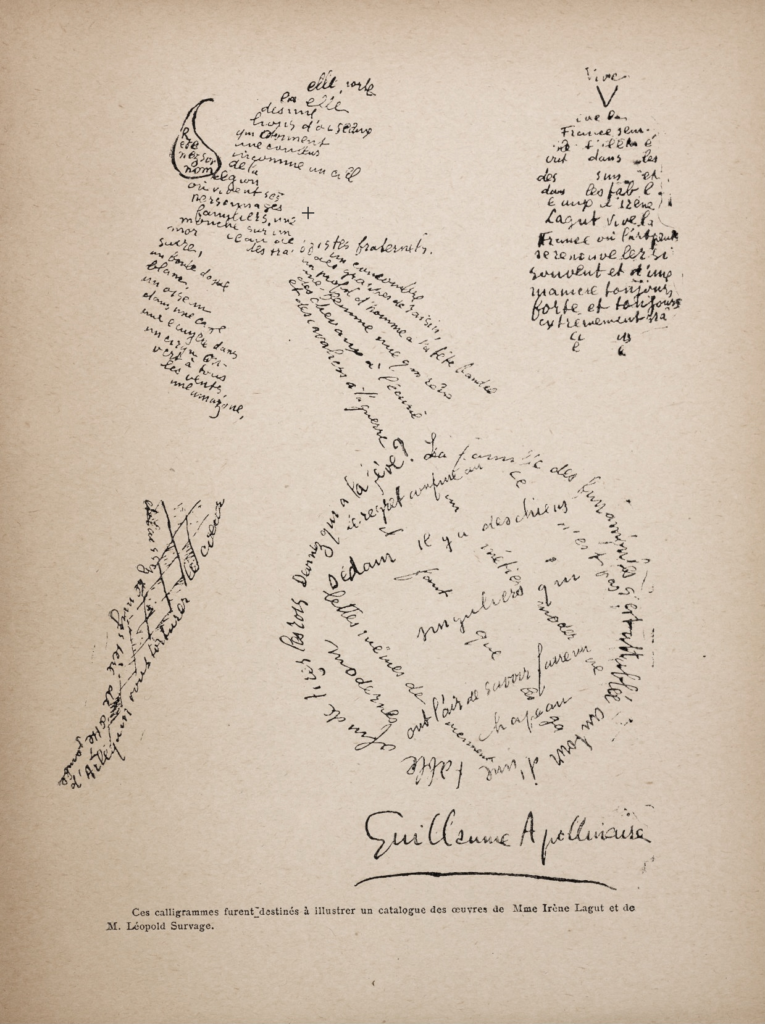
Guillaume Apollinaire, Poème Calligramme
Source: Wikimedia Commons
I
Shabdarthau samanupraptau bhavatah sampradayinah
(An accurate translation preserves cultural and linguistic heritage.)
In the vast and intricate world of human expression, literary translation stands as one of the most delicate and demanding arts. It serves as a bridge between cultures, a doorway through which stories, emotions, philosophies, and entire worldviews travel from one language to another. At its best, translation enriches humanity by making distant voices accessible and fostering understanding across borders. At its most challenging, it reveals the fundamental limits of language itself.
A skilled translator must do far more than simply converting words from one tongue to another. They must carry the soul of a text across linguistic boundaries while preserving its rhythm, cultural weight, emotional depth, unspoken resonances, and artistic intent.
Yet not every work makes this journey gracefully or completely. Some texts seem to resist translation with a quiet but stubborn loyalty to their original language. Its unique sounds, idioms, cultural references, historical echoes, and social contexts are so deeply woven into the fabric of their native tongue that moving them feels almost like an act of violence against the work itself.
Language is never a neutral vessel for ideas. It is a living, breathing organism shaped by centuries of history, geography, migration, conquest, and everyday human struggle. Some literary creations exploit the unique properties of their language so thoroughly that translation becomes extraordinarily difficult, if not impossible, without fundamentally altering the essence of the work.
Let’s explore why certain literary works remain elusive, forever tethered to the soil from which they grew, and what this resistance teaches us about literature, culture, and the human experience.
James Joyce’s Finnegans Wake remains one of the most formidable challenges in the history of literary translation. This modernist masterpiece is less a conventional novel than a vast, dreamlike linguistic experiment spanning over six hundred pages. It revels in puns, portmanteaus, multilingual wordplay, cyclical structures, and deliberate distortions of English. The opening word, “riverrun” elegantly merges the image of a flowing river with the idea of running, immediately establishing the fluid, cyclical nature of the entire book. One of its most famous passages features the thunderword “bababadalgharaghtakamminarronnkonnbronntonnerronntuonnthunntrovarrhounawnskawntoohoohoordenenthurnuk” — over a hundred letters long — blending sounds from dozens of languages to imitate the crash of thunder in a way that is both chaotic and musical.
Translating Finnegans Wake has been compared to attempting to rebuild a cathedral using entirely different stones and architectural traditions. French translator, Philippe Lavergne, devoted decades to the project, and his 1982 version is considered a monumental achievement in its own right. Yet many critics have observed that his translation, while heroic, became something distinctly French in character. The dense polyglot texture and sonic playfulness that define Joyce’s original simply could not be fully replicated.
Thus, what emerges in translation is often a new artistic creation rather than a faithful mirror of the source. This raises a profound question that has haunted every serious translator throughout history: when does translation stop being translation and become an act of rewriting or reinvention?
Beyond pure linguistic complexity, many works are inseparable from their specific cultural and philosophical contexts. The haiku of Matsuo Bashō, the wandering 17th-century Japanese poet, offers one of the clearest and most beautiful illustrations. His most famous poem — “An old silent pond / A frog jumps into the pond— / Splash! Silence again.” — appears remarkably simple and accessible when rendered in English. However, its true power lies in the Japanese aesthetic concept of mono no aware, a subtle and profound awareness of the fleeting beauty of existence, tinged with gentle melancholy and serene acceptance. The poem also relies heavily on kigo, or seasonal words, that evoke rich layers of cultural and emotional associations for readers steeped in Japanese traditions and Zen philosophy.
Without this shared cultural framework, much of the haiku’s spiritual depth evaporates in translation. A Japanese friend once described her experience of teaching Bashō to a group of American university students. When she attempted to explain the nuances of mono no aware, one student responded innocently, “Isn’t it just sadness?” That single question revealed how vast the cultural gulf can be. What feels like a moment of profound spiritual insight in one tradition may register as little more than a pleasant but ordinary nature sketch in another.
Dialects and regional idioms present yet another formidable layer of difficulty. They carry not only literal meaning but the lived texture of a particular place, time, class, and social reality.
Mark Twain’s Adventures of Huckleberry Finn derives much of its vitality, humor, and moral force from the regional and colloquial speech patterns of the 19th-century American South. Huck’s rural Missouri Pike County dialect and Jim’s southern Negro vernacular are not decorative stylistic touches, they are essential to the novel’s powerful exploration of race, freedom, friendship, morality, and hypocrisy in a divided society. Translators attempting to convey these distinctive voices face an almost impossible dilemma. In one early German translation, the translator substituted regional Swabian dialect to approximate southern American speech. While inventive, this choice altered how German readers perceived the characters, linking them more closely to rural simplicity than to the complex racial and social tensions of Twain’s Mississippi River world.
Contemporary fiction continues to face parallel challenges. Chimamanda Ngozi Adichie’s Half of a Yellow Sun masterfully integrates Nigerian Pidgin and Igbo expressions into English prose. These linguistic elements convey the rhythm, humor, resilience, and cultural specificity of Nigerian life during the turbulent years of the Biafran War. Translating such a hybrid linguistic texture into Spanish, French, German, or other languages requires creating equivalents that inevitably carry their own cultural baggage, subtly shifting the novel’s original Nigerian soul and emotional impact.
Some works derive their meaning not only from words but from their physical or visual form on the page. Concrete poetry provides striking and immediate examples.
Guillaume Apollinaire’s Calligrammes arranges words into recognizable visual shapes — a heart, a fountain, a star, a watch, or even a horse — merging literary art with visual art in a revolutionary way. Translating these poems into languages with different writing systems, such as right-to-left Arabic scripts or character-based Chinese, inevitably disrupts the intended visual impact and meaning. The poem’s essence is inseparable from its physical appearance.
Ancient texts add yet another fascinating dimension of difficulty. The Epic of Gilgamesh, one of humanity’s oldest surviving literary works, was originally inscribed in Akkadian cuneiform on clay tablets. The very medium, the wedge-shaped marks carefully pressed into durable clay, contributes to the powerful sense of encountering something ancient, monumental, and almost sacred. When George Smith first translated portions of the epic, he successfully conveyed the core narrative but inevitably lost the tactile and historical resonance of the original artifacts.
The same holds true for the Persian poetry of Jalaluddin Rumi. The central Sufi concept of ishq (divine love) encompasses spiritual, emotional, and ecstatic dimensions that English words like “love” or “passion” cannot fully capture. Scholarly translations sometimes render Rumi’s passionate, musical verses into surprisingly dry, academic prose that loses the original fire.
II
Here’s a more personal way I understand this.
I’ve been sitting with a particular kind of failure for years. It’s not just mine; it belongs to anyone who’s ever tried to translate a Bengali poem and felt the ground shifting under them. It feels like reaching for an emotion and finding that the English language simply doesn’t have a pocket for it.
The word is bhaab (ভাব).
There’s no English equivalent. And honestly, that’s where any real conversation about translation has to start — not with James Joyce’s wordplay or the layers inside a Basho haiku, but with something more unsettling: what do you do when the feeling itself can’t be translated? When the word in the original language grew around an experience the way bark grows around a wound?
Bhaabisn’t quite “emotion.” It isn’t “mood” or “essence” or “spiritual state.” It’s kind of all of those things at once, held together by centuries of Bengali literary tradition — devotional poetry, Baul singers wandering the red-clay fields of Birbhum, Tagore at his desk in Santiniketan already knowing he cannot quite say in English what he means in Bengali. Bhaab is the experience that exists before the word. That’s where the translation problem starts.
In the Baul tradition — this remarkable stream of mystic folk philosophy running through rural Bengal — bhaab isn’t something you create. It arrives. A Baul singer doesn’t choose a bhaab any more than you choose to be moved by a piece of music. It just opens something inside you, sometimes in the middle of a song, sometimes standing in a field. The 19th-century saint-poet Lalon Fakir wrote hundreds of songs where bhaab is simultaneously what he’s singing about, how he’s singing, and where the singing is trying to go. Those songs have been translated into English, French, German, and more. Every translation gets the words right. None of them makes bhaab actually land on the reader. That’s not the translator’s fault. It’s just the nature of what’s being attempted. Some experiences can’t be packaged and shipped. You have to already be inside the tradition to receive them.
Then there’s the word biroho. Usually translated as “separation” or “longing,” but in the Vaishnava tradition it carries so much more than that. It’s not just the pain of being away from someone you love. It’s understood as the very thing that makes love possible. Separation from the divine isn’t a tragedy — it’s the crucible where devotion gets deepened and refined. Biroho is what compels the singer to sing in the first place. When Tagore uses it, Bengali readers feel centuries of devotional thought vibrating in that single word. English readers get “longing.” The ground beneath it has simply vanished. The translation is beautiful. But it’s beautiful the way a pressed flower is beautiful, preserved, but removed from the living plant.
Similarly, ananda becomes “joy” in English. But in the Upanishadic tradition, ananda isn’t an emotion that comes and goes. It’s the ground all feeling rests on. “Joy” shows up cheerfully and then leaves. Ananda is what’s underneath.
III
I write poems in Bengali and in English. They’re not translations of each other. They’re not even really in conversation. Over time I’ve come to understand that they’re two different writers living inside the same body.
I grew up in Tripura, where Bengali, Kokborok, and Hindi exist side by side in daily life at the market, at school, at the edge of a paddy field. You might move between three languages in a single hour. I understood early, without having words for it, that language isn’t just a container for who you are. It’s a shape you take on.
My Bengali self reaches back through Tagore, Jibanananda Das, Shakti Chattopadhyay, and further still through centuries of devotional poetry and Baul saints. My English self has none of that ancestral weight. It’s newer, more provisional, more self-conscious. Neither is more authentic. But they’re genuinely different.
When I write in English, I edit the feeling before I find the word. When I write in Bengali, I start inside the feeling and let the word come from there. The sequence is reversed. The poet is reversed. And that reversal is where I understand, in my gut, what every translator working between these two traditions has to navigate… not a gap between vocabularies, but a gap between two ways of being in the world.
The worst thing a translator can do is to pretend the gap doesn’t exist and thus produce smooth, confident English that gives you no sense of crossing into another world. That kind of courtesy erases the very thing that made the journey worth attempting. It makes the foreign comfortable, which is just a quiet way of making it invisible!
The best translations leave you slightly off-balance. They let a strange word stay strange. They let a silence go unexplained. They say, between the lines: you’re holding something from another world, and it won’t fully become yours, and that’s okay.
Here’s the paradox at the heart of translation: the deeper your knowledge of both languages, the more clearly you can hear the silence between them.
A beginner working with a dictionary often produces something fluent and false, because they can’t hear what they’re missing. The master translator who has dreamt in both languages, who can feel the original the way a musician, hears a score they can’t reproduce, the way someone feels the loss most acutely.
Gayatri Chakravorty Spivak describes the process not as mastery but as surrender: letting yourself be changed by the text rather than changing it. To surrender to a Bengali text is to acknowledge, openly, what you can’t bring with you. Carry as much as you can across the river. And then name, honestly, what fell into the water. That naming isn’t defeat. It’s respect for both languages, and for the reader, who deserves to know the depth of what they’re not receiving.
I keep coming back to Tagore in London, 1912, his pages spread before Yeats, who read them and wept. Yeats didn’t weep because he understood completely. He wept because he understood almost… because he felt the edge of something vast that kept pulling back as he reached toward it. He was standing at the precipice.
That almost is the most honest thing translation can offer: not the original, not a replica, but the experience of genuinely reaching toward something that recedes.
For those of us who write in two languages, this gap isn’t theoretical. It’s daily. It’s the moment you sit with a poem in one language and know, before you’ve written a single word in the other, that you’ll arrive on the far side with something real … maybe even beautiful… but not the same thing. Not the same light.
In Bengali, the word for that far shore is parabar. It runs through Tagore’s verse as both a physical place and a metaphysical one. Every translation is a crossing toward the parabar. You arrive. But the shore you left from looks different from here — smaller, stranger, more luminous, and further away than you imagined.
What stays with you isn’t the perfect crossing. It’s the honest attempt. Every translation that marks what it couldn’t carry becomes its own testimony to how rich the original was and proof that something was present in the source text that exceeded what any single language could hold. The gap between a poem and its translation isn’t a wound. It’s a measure of the poem’s depth.
And the reader who learns to stand in that gap… patient, curious, not needing to fully possess what they’re reading, discovers something no smooth, comfortable translation could ever give them: the direct experience of a world that insists on remaining, in some essential way, itself.
Samikhrtah anuvadah tattva-darsanam bhavati.
(A refined translation does not complete the journey.
It teaches us how far there is to go.)
REFERENCES:
Adichie, Chimamanda Ngozi. ‘Half of a Yellow Sun’. Fourth Estate, 2006.
Apollinaire, Guillaume. ‘Calligrammes: Poems of Peace and War, 1913–1916’. Translated by Anne Hyde Greet, University of California Press, 1980.
Bashō, Matsuo. ‘The Essential Bashō’. Translated by Sam Hamill, Shambhala Publications, 1999.
Bassnett, Susan. ‘Translation Studies’. 4th ed., Routledge, 2014.
Joyce, James. ‘Finnegans Wake’. Faber and Faber, 1939.
Rumi, Jalaluddin. ‘The Essential Rumi’. Translated by Coleman Barks, Harper One, 1995.
Smith, George. ‘The Chaldean Account of Genesis’, 1876.
Spivak, Gayatri Chakravorty. ‘The Politics of Translation’, Routledge, 1993.
Tagore, Rabindranath. ‘Gitanjali’. Macmillan, 1913.
Twain, Mark. ‘Adventures of Huckleberry Finn’. Charles L. Webster and Company, 1885.