Translated from the Bengali by Paromita Sengupta
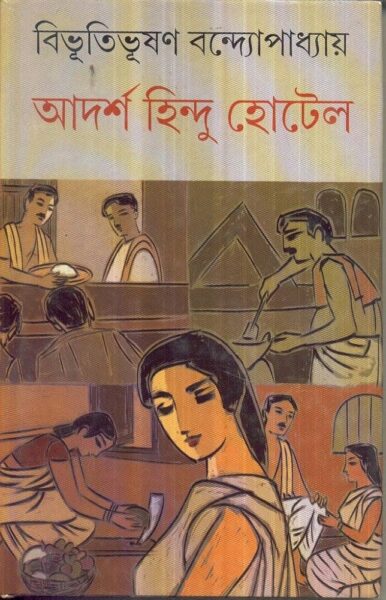
ADORSHO HINDU HOTEL
Bibhutibhushan Bandyopadhyay
Translated by Paromita Sengupta
“Bechu Chakkotti’s Hotel, Ranaghat Railway Market.” Even if it isn’t written in big, bold letters across the storefront, everyone knows this is Ranaghat’s only authentic Hindu hotel. As the railway market has undergone an incredible transformation over the years, the hotel’s fortunes have risen along with it. Within a decade now, the hotel has acquired a sturdy brick-and-mortar building, and four Brahmin cooks and helpers struggle day and night to keep pace with the overwhelming rush of customers.
Bechu Chakkotti—over fifty, of medium build, neither fair nor dark, gray-haired—sits in the front room on a wooden cot, his elbow resting on a wooden cashbox. It is 10 a.m. The Bonga-line train has just arrived, and some passengers have begun to spill out through the exit gates onto the main road.
The hotel’s servant, Moti, stands by the roadside, hollering:
“This way, Babu! Hot rice is ready! Fish curry, dal, vegetables, steaming hot rice! ADORSHO HINDU HOTEL, Babu!”
Two men, swayed by Moti’s eloquent persistence and ignoring the warm, welcoming invitations from the staff of Jodu Barujjye’s hotel next door, step into Bechu Chakkotti’s hotel.
“Here, put your bundle here. Wait, sir, you have to buy a ticket here—which class would you prefer to eat in? Fust class or seken class? Fust class five annas, seken class three annas—”
This is the hotel’s rule: one has to pay money to buy a ticket (a chit with a number and class written on it) from Bechu Chakkotti before going inside. One of the cooks sits there to collect the customer’s ticket and seat them in their designated spot. The dining area is divided into two parts by a bamboo mat partition. On one side is the first class, and on the other, the second class. Once the customers finish their meal and leave, all these tickets are submitted to Bechu Chakkotti—by tallying them, the money in the cashbox will be balanced, and the amount of remaining rice and curry will be cross-checked so the cooks cannot steal anything.
The servant came inside and announced, “Only four customers in all. Two of them went over there.”
Bechu Chakkotti said, “Let it be. You go a little further ahead—it’s almost time for the Shantipur train to arrive. This one usually has a couple of customers anyway. And tell the cook not to put on another batch of rice before the Shantipur train arrives. One pot’ll be enough for now.”
Just then, the hotel’s maid, Padma, entered the room and said, “Give me some money, Babu, I’ll get some curd.”
Bechu asked, “Why do we need curd?”
Padma smiled. “Someone from the fusto class. They’ve asked for curd, ripe bananas . . .”
Bechu said, “Who is it? A customer?”
“Of course, a customer. Who else? He’ll pay. My nephew is coming from our native village on this Shantipur train.”
“No, no—he doesn’t need to pay. He’s just a young lad, coming for a day or two—why take money from him? Here, take the money.”
Bechu never says such things to anyone else, but with Padma Jhi, it is a different matter. Whatever Padma says is carried out in this hotel. There is no one who can speak over her. Of course, wicked people spread all sorts of malicious rumors, but one cannot pay attention to such idle talk.
The sound of the Shantipur train approaching could be heard in the distance.
The servant was heading to the station to bring in customers. Bechu Chakkotti reminded him, “You’ll lose your job if you can’t bring in more customers, keep that in mind. If it doesn’t cover my expenses, why should I bother keeping a servant? Last week, you brought in only twenty-three customers in total—can a hotel run on that?”
“I’m tired of telling you repeatedly,” quipped Padma Jhi, “raise the three-anna rate to fourteen paisa, and do away with all this ‘fusto-class’ business. How many customers actually eat in fusto class? Jodu Barujjye’s hotel has reduced its rates—I hear—”
Bechu said, “Shh, shh, speak a little softer, will you? If anyone hears this right now—”
Just then, Moti Chakor returned, bringing two customers with him.
Bechu said, “Come in, sir, put your bundle here. Which class will you gentlemen be eating in? Five annas or three annas—”
One of them inquired, “Is that Brahmin cook of yours still here? We came specifically to eat his cooking. Ever since we ate here last time, we haven’t been able to forget its taste. Will there be meat?”
“No, sir, meat isn’t ready at the moment—however, if you place an order, then later this evening—”
The man said, “We have come to attend a court case, you see—if we win, by the grace of Porama and Siddheshwari—then we’ll definitely have to stay at the hotel today. We have work at the lawyer’s house tomorrow—in that case, we want three seers of meat later this evening. But we want that same Brahmin cook to prepare it. Otherwise, we’ll go elsewhere.”
Once they bought their tickets and entered the dining room, Padma Jhi let out her frustration: “Hope that rogue of a cook doesn’t hear this. I don’t know why people praise his cooking so much—it’s just awful!”
“Go get the tickets from inside,” said Bechu. “Let me settle this shift’s accounts. There are no more trains right now, anyway—the next one is the 1:00 p.m. Murogacha local—”
Padma said, “Why, what about the Assam Mail?”
“Hardly any customers come on the Assam Mail anymore! We would get at least eight to ten customers daily from the Assam Mail in the past—what a mess the market situation has become—”
Padma Jhi went inside and brought the tickets from the Brahmin cook, and said, “Now, listen to this nonsense: all the dal for the fusto class is finished. Look at Hajari Thakur’s antics! And here’s this gentleman singing his praise to the high heavens: ‘Your cooking is this, your cooking is that!’—utter nonsense! This is exactly what I can’t stand. Now tell me, what shall we do about the dal—”
“Did you check how much dal is left?”
“Almost nothing. At most, there might be enough for about three people—”
“How much dal did you give him?”
“I gave him enough moong dal for ten people separately for the fusto-class fish-head curry—and a mix of masoor-khesari for thirty people in seken class—”
“Call Hajari Thakur—”
Padma Jhi fetched Hajari Thakur.
The man is around forty-five or forty-six years old, slim and dark. He appears to be a harmless, good-natured person.
Bechu Chakkotti said, “Hajari Thakur, how did the dal fall short?”
Hajari Thakur replied, “What can I say, sir? I didn’t serve any more dal to the customers than I usually do every day. What can I do if it fell short?”
Padma Jhi snapped, “You are wicked to the core, Thakur! I clearly saw, after hearing those customers praise your cooking, you kept ladling generous helpings of the fish-head murighanto onto their plates. Looks like they gave you some tips too—”
“You know exactly how much tip I get in this hotel, Padma-didi,” said Hajari. “Does anyone even give me a bidi to smoke—and I’ve been here for five years now. You’re the only one who sees me getting tipped . . .”
Padma snarled, “Don’t talk back to me, I’m warning you. Padma Jhi isn’t afraid to speak out. Didn’t the fusto-class gentlemen buy you an undershirt during Puja?”
“Oh please—as if they bought me a grand undershirt! It was just an old ganji—”
Bechu Chakkotti said, “Go, go, Thakur, stop arguing. If more customers arrive, the cost of the dal will be deducted from your salary.”
“Why, sir, what is my fault here? Padma-didi measured out dal for eight people, but eleven people ended up eating—”
Padma came up to Hajari Thakur, gesticulating wildly and glaring at him. “Eight people’s dal, measured out? You wretched, wicked weed addict! Didn’t I measure out half-of-ten, that is, five-powa dal and give it to you?”
Hajari Thakur didn’t dare protest any further.
Padma Jhi wasn’t one to let it go so easily—but in the meantime, customers had started arriving, so she stopped her jabbering and left. Hajari Thakur, too, went inside.
It is nearly two-thirty in the afternoon.
Hajari Thakur sat down alone to eat in the dining room. Tiny portions of rice and vegetable mash scraped from the bottom of the large cooking pans were all that remained for him to eat. The leftover dal and fish had to be served onto Padma Jhi’s large plate—every day around one-thirty she would take whatever was left of the kitchen’s dal, curry, and fish home with her, whether there was anything left for the cooks or not.
The other Brahmin cook is from Odisha; his name is Ratan Thakur. He lives near the hotel and takes his rice and curry home.
Hajari has no one here. He stays in the hotel and eats in the hotel. This is his fate every single day. Working on an empty stomach until two-thirty in the afternoon, just some hard-boiled grains of rice, some days a tiny bit of dal, and some days not even that—this is his allotted share. If there is extra rice left in the pot, Padma Jhi will say, “Who is going to eat so much rice? That’s enough to feed three people—add a bit more rice onto my plate.”
Every day, as he sat down to eat, Hajari Thakur would think—it would be nice if there were a little more rice, I could have eaten it with some tamarind. That Padma is such an outright wicked woman—she can’t even bear to see anyone eat a full meal. At Jodu Barujjye’s hotel, the Bamun cook gets to eat a full plate of rice at eleven in the morning; is there any chance of that happening here? Like master, like mistress (Hajari Thakur found great amusement in silently calling Padma Jhi the “mistress”—there is comfort indeed in saying silently what cannot be said aloud!).
After the meal, there is a break of only two and a half hours.
Again, right at five o’clock, the cooking pot has to be set on the stove.
Ratan Thakur goes home to sleep during this time, but Hajari Thakur spends it sitting alone either at the temple by the bank of the Churni River or in the natmandir of the Radhaballabh temple.
There is a reason why he stays awake and spends this time sitting alone.
For Hajari Thakur, this is his time to think. Apart from this time, he gets no leisure to think in solitude. He and the others remain busy cooking until seven in the evening, serving customers until eleven at night, eating their own meals until twelve, and after that, settling the accounts of rice and lentils with the proprietor. One gets no chance to go to bed before one in the morning—where is the time to be alone and think, even for a brief moment or two?
He quite likes this spot by the bank of the Churni River.
On the other side lies the unpaved road leading to Shantipur. People crossing back and forth on small boats; villages with their bamboo groves, silk-cotton trees, open fields, farmlands with pulse crops, wild-plum and bean hedges encircling people’s homes.
Hajari Thakur lit a bidi and began to contemplate.
It has been five years now at Bechu Chakkotti’s hotel.
He still remembers the very first day he arrived in Ranaghat and stepped into the hotel. Coming from Gangnapur to Ranaghat, he went straight to Bechu Chakkotti’s hotel in search of work.
The owner was sitting right out front. He said, “What do you want?”
Hajari said, “Sir, I’m a Brahmin cook, looking for work. Is there any work for me here, at your hotel?”
“What’s your name?”
“Hajari Debsharma, surname Chakraborty, sir.”
Hajari’s father had taught him to state his name in this exact traditional manner.
“Where is your home?”
“One has to get off at Gangnapur station and go to the village of Eroshola.”
“Do you know how to cook?”
“Try me, Babu, let me cook for a day and see for yourself! Meat, fish—whatever you give me, I can manage it all.”
“All right, you’ll have to cook for three days for free—after that, I’ll pay you a salary of seven rupees, with free meals. If you agree, start working from today.”
From that day until now, Hajari’s salary hasn’t increased by a single paisa beyond those seven rupees. Yet, all the customer babus praise his cooking—even though he has never heard a single word of praise from Padma Jhi’s mouth, let alone a kind word; given the chance, she would gladly chop him to pieces with her sharp fish slicer. Where would a poor man like him go if he left his job in times as tough as these? Oh well, he doesn’t dwell on that too much. He holds a wish in his heart; if God fulfills it someday, then all his regrets will vanish.
He has learned the hotel business inside out. He will open a hotel of his own.
Outside the hotel, a sign will read:
HAJARI CHAKRABORTY’S HINDU-HOTEL
Ranaghat
A place for all gentlefolk to eat at reasonable prices and rest.
Come, see for yourself! Try us out!
Hajari pictures himself leaning back against a bolster cushion just like the proprietor and selling meal tickets. The Brahmin cooks and the maid will address him as “Babu.” He will go to the market himself to buy fish and vegetables, instead of dumping all the responsibility onto a maid like they do in this hotel. Hajari will charge money only after making customers happy with good food. Over these past few years, he has come to realize that if people get quality food and good cooking, they won’t mind paying a slightly higher rate either.
He will not engage in fraud like this hotel does; he will not mix cheap khesari lentils with red masoor lentils, nor will he pick out and buy rotten, worm-eaten eggplants from the market, or cheap frozen fish for his hotel.
There is no proper resting arrangement for customers here—those who really want to rest do so on the owner’s mattress and smoke a bidi or two. But Hajari feels that if they were offered a nice place to rest, more people would visit the hotel; many prefer to lie down for a bit after eating. He will keep a separate room in his hotel for casual customers to rest. There, a thick mat and bedsheet will be spread over a wooden bed; there will be pillows and arrangements for smoking; if someone wishes to take a nap, they can easily do so. Eat, drink, rest, smoke, and leave. No hotel in Ranaghat has such arrangements, not even Jodu Barujjye’s hotel. To run a business well, these arrangements are necessary. Merely going to the station at arrival times and shouting “Come, sir, good Hindu hotel” will not work for long.
Customers look for good food and comfort. People will flock to whoever can offer that.
He knows, of course, that if he sets up a resting room in a hotel today, tomorrow, before you know it, all the Hindu hotels across Ranaghat market will copy him and provide resting rooms if it helps attract customers.
Even so, once a reputation is established, the originator of the idea gets the advantage. Besides, Hajari has so many other plans in mind; why just a resting room for customers? Those who come for court cases might want to play cards for a while after their meals, following a whole day’s toil—that arrangement will also be made. They won’t have to pay for betel leaf or tobacco; they can prepare the paan themselves or let the hotel servant prepare it for them.
As he sits alone by the banks of the Churni River, numerous ideas like these come to his mind. But will it ever happen? Will the hope in his heart ever be fulfilled? He is already over forty-six—he hasn’t been able to achieve anything his entire life, nor has he been able to escape his seven-rupee-a-month job till now. A poor man with dependents, he cannot figure out how anything will ever come to pass.
Yet why does he think about all these things every day, sitting by the banks of the Churni River? He does, simply because he likes to daydream.
However, Hajari is not one to be deterred just because he has aged. Forty-six years is not much of an age. He still has many days left to live. He has enthusiasm for work; if he can open a hotel, he will show how to earn a good reputation. Once he opens the hotel, he will have no regrets even if he dies.
Time has slipped away. He can no longer sit around for long. Padma Jhi must have lit the stove by now, and if he arrives late, he will have to endure her reproaches. Such a gossipmonger! This woman! She has spread the word that he smokes ganja—even though he has never touched weed in his life.
As he returned, a small market near Radhaballabh-tala lay along his route.
Hajari Thakur prays devoutly at this spot every day around this time.
“Baba Radhaballabh, I throw myself at your feet, Thakur! Fulfill the desire of my heart. I can no longer take Padma Jhi’s harsh scoldings. May I open a hotel right beside the proprietor’s hotel, right before Padma Jhi’s eyes.”
Upon returning to the hotel, Hajari found that Ratan Thakur had not arrived yet, and Padma Jhi had gone somewhere after lighting the stove.
Bechu Chakkotti woke up from his afternoon nap, returned from his residence, and immediately called for Hajari.
“Listen carefully. A few gentlemen will feast on meat and rice tonight; they’ve even paid me in advance. Make sure to wrap up early—they’ll catch the Murshidabad train. Hope you won’t forget anything. Why isn’t Ratan back yet?”
Hajari felt hurt—why didn’t Bechu Chakkotti ever tell him that he cooks very well, and so he should cook the meat himself? He knows that these people never compliment his cooking, yet what immense effort he has put in to learn this craft!
And how did he learn to cook so well? Well, that’s a long story—more of a history, actually. When he was very young—about nine or ten—there lived in his village, Eroshola, an old Brahmin widow. She was famous for her extraordinary cooking skills, both in and beyond her village.
Hajari’s mother once said to her, “You’re getting old, Khuri-ma; who knows when you will pass away, why don’t you teach me some of your skills? I’ll sing your praise forever.”
She agreed, saying, “All right, Bou, I will leave one thing with you. I will teach you how to cook the vegetarian mishmash, the chochchori, before I go.”
And thus she taught Hajari’s mother that one single dish—the mixed vegetable mishmash. But that one dish was enough for Hajari’s mother’s reputation to spread across eight to ten neighboring villages. The dish might sound simple enough; what’s so special about it, one might wonder. But the answer to that question lay in tasting the vegetarian mishmash prepared by Hajari’s mother. Sad to say, she is no longer alive; she passed away last year.
Hajari has his mother’s culinary talent—he cooks everything well, whether meat or fish. But his chochchori is so wonderful that anyone who has tasted it once at Bechu Chakkotti’s hotel is sure to return to have it again. Even though there are so many hotels in the railway market, they would never go anywhere else.
Today, too, the responsibility of cooking the meat fell upon him! The customers were all praises for the dish, as usual. But there was nothing for Hajari, as usual, except for the praises from the customers. Padma Jhi didn’t offer a single word of encouragement to him; neither did Bechu Chakkotti.
He sat down to eat late at night. After preparing such delicious meat with his own hands, he was left with nothing for himself. Whatever remained was sent to the master’s residence. Even after that, whatever little bit was left over, Padma Jhi scraped it clean and took it away.
Such a problem occurs every day at mealtime. Hardly anything is left for him; some days even the rice falls short—let alone fish or meat. Although he is forty-six, Hajari has a healthy appetite and can eat well—yet most days, he is left hungry even after a meal.
It was half past twelve at night. The master had closed the accounts and left. No one stayed overnight at the hotel except him and Moti, the servant. Padma Jhi had left long ago—she never stays past ten o’clock at night.
Moti Chakor said, “Come on, Thakur, there’s a jatra performance taking place at the small market, do you want to go?”
“A jatra performance so late at night? Are you crazy! After working hard all day, does one still have energy for such fancies? I won’t go—go if you want. When you return, knock on the storeroom window, and I’ll open the door.”
Moti is a young lad; he enjoys life. He left.
A little later, someone knocked at the door from the outside. Hajari got up, opened the door, and was surprised to see Jodu Barujjye, the owner of the neighboring hotel, standing outside. They were competitors. What could he possibly have in mind coming here so late at night? He never comes over! Hajari’s mind filled with awe—Jodu Barujjye was also the owner of a hotel, so to Hajari, he was a person equal in standing to his own master, a master of sorts.
Jodu Barujjye asked, “Who else is here?”
Unable to understand the purpose of Jodu’s visit, Hajari had been racking his brains. He replied humbly, “No one, Babu, only me. Moti was here, but he went to the small market for the jatra—”
Jodu Barujjye said, “Let’s sit inside the room. I need to talk to you.”
Sitting inside, Jodu Barujjye took a seat at Bechu Chakkotti’s desk, looked around, and asked, “How much do you get paid here, Thakur?”
“Seven rupees, sir, plus food.”
“Do they provide clothing?”
“Two pieces of dhoti a year.”
Jodu Barujjye cleared his throat and said, “Listen, will you come work at my hotel? I will give you ten rupees and meals. You will get three dhotis a year. Plus, all the basic necessities will be taken care of. Are you willing?”
Hajari was absolutely astonished. He couldn’t speak for a moment. Then he said, “Babu, I can’t say anything right now. I’ll think about it and tell you.”
“What’s there to think about? My word is my deed. Leave this hotel and come to mine starting tomorrow; I am ready to employ you from tomorrow itself. Though, mind you, I don’t want any unpleasantness with Bechu Chakkotti. He is a businessman, and so am I.”
Hajari felt his head spin. Is anyone watching? Is Padma Jhi eavesdropping somewhere? He quickly said, “I can’t commit to anything right now, Babu. I’ll think about it and let you know tomorrow. Come back around this time tomorrow night.”
Jodu Barujjye left.
The rumor that Hajari smokes ganja is not entirely false; he does smoke, though very secretly and occasionally. After everything that happened tonight, he couldn’t help but prepare a chillum of ganja. In his whole life, no one had ever recognized him as a good man or a good cook and offered to reward him with a better meal; after all, empty praises don’t fill empty stomachs!
Jodu Babu himself came over to offer him a job for ten rupees a month (plus meals, washerman, barber, and smoking expenses)!
He has been in the Ranaghat market for all these days—he never mingles with anyone. He doesn’t like to mingle. The dream of his life will not be fulfilled by hanging out with ordinary people, idling away, and smoking ganja. He must toil, understand the market, learn bookkeeping, and gather every trick of the trade needed to run a good hotel. To succeed in this world, to hold his head high before society, to hear his name on others’ lips—for all of that, a lot of effort, a lot of hard work are required. What good would come from hanging out, smoking ganja, or roaming around listening to community performances at the small market like Moti the servant?
It was very late at night. His head felt hot. There was no sign of sleep.
There was a knocking at the door. Hajari got up and opened it, guessing Moti must have returned. Entering the room, Moti was surprised: “Haven’t you slept yet, Thakur? You’re still wide awake!”
Hajari had hidden the ganja chillum before going to open the door for Moti. He said, “It’s so hot, how can one sleep after working in the heat of the hearth all day—did you watch the jatra?”
Moti said, “No, it’s absolutely packed, no room for us. So I came back. Let’s go somewhere else, will you come, Thakur-moshai?”
“Where?”
“Somewhere in the neighborhood. Come on—since you’re not sleepy, why not just take a walk? You never go anywhere—”
Hajari said, “You go, you’re young and robust. I’m forty-six, almost the same age as your father. How can you say such things to me? . . . Go ahead and do whatever you feel like doing.”
“Then please don’t tell Babu or Padma-didi anything, Thakur-moshai, I beg of you, I am falling at your feet.”
Surprisingly, Moti’s words brought a new kind of thought to Hajari’s mind. He has high ambitions; if he wastes time roaming around at night seeking pleasures like Moti, God will not show him mercy. Moti, however, didn’t go back out again and went to lie down instead in the utensil room (where the hotel’s brass and bell-metal plates and bowls are kept in a chest next to the kitchen—every night after they are washed and scrubbed clean, Bechu Chakkotti stands there in supervision, counts them, puts them away in the chest, and takes the key with him). Hajari usually sleeps in the utensil room as well, but today he spread his old mat and lay on the floor of the outer room.
No—he will not go to Jodu Babu’s hotel. Being a cook in a hotel is the same everywhere. This hotel has Padma; who knows who is at that other hotel? Besides, Bechu Babu has been his provider for five years. It is not right to abandon the provider who has fed him for so long out of greed.
He will open a hotel himself—that is his goal. As long as he has to work as a cook, he will do so in this hotel. He will not go anywhere else. After that, if Radhaballabh shows mercy, it will be a different story.
***
TRANSLATOR’S NOTE
The “Hindu hotel” exists at an intersection of ritual tradition and commercial modernity. In contemporary discourse, Hindu identity is often flattened, with strict vegetarianism frequently brandished as a touchstone of religious purity and authenticity. Bibhutibhushan Bandyopadhyay’s novel offers a vital historical counterpoint to this narrow view. Grounded in the historical reality of the “Hindu hotels” that once dotted Bengal, the story reveals a nuanced social landscape that upends simplified assumptions about caste, food, respectability, and faith. A “Hindu hotel” in this era served varieties of fish and mutton without any kind of ideological contradiction. In fact, customers in the novel seek out the Brahmin cook Hajari Thakur precisely for his mastery in preparing meat. What makes the establishment recognizably “Hindu” is not vegetarian food but a promised network of practices surrounding cleanliness, commensality, ritual acceptability, and caste-sanctioned food preparation. This distinction matters. As Utsa Ray’s work on colonial Bengali food culture demonstrates, the formation of Bengali cuisine involved complex negotiations among caste, class, gender, community, and ideas of respectability rather than a simple opposition between vegetarian and nonvegetarian food (Ray 2015).
The novel makes these negotiations tangible through the figure of the rasuye-Bamun, the Brahmin cook, Hajari Thakur. His caste identity gives his labor ritual value: the Brahmin cook’s presence helps guarantee the acceptability of the food to orthodox Hindu customers.
Yet ritual status does not translate into economic power. Hajari remains one of the most precarious figures within the hotel. After five years of employment, his salary remains seven rupees a month; he is subject to verbal humiliation, threatened with wage deductions, and frequently left without enough food himself.
Food here is therefore not merely cuisine, heritage, or cultural identity. It is also labor. The pleasures associated with Bengali cooking are produced within relations of employment, scarcity, ownership, and unequal access. Hajari possesses the culinary knowledge on which the hotel’s reputation partly depends, but he does not initially possess the economic means to convert that knowledge into security.
A related complexity lies in the term bhadrolok. When Hajari imagines opening his own establishment, his signboard promises affordable meals and rest for the bhadrolok, conventionally rendered as “gentlefolk.” Historically, “bhadrolok” has functioned as a contested category of Bengali respectability shaped by caste, education, occupation, cultural capital, and class privilege. Its implied opposite, “chhotolok,” similarly does more than designate poverty: it can collapse economic position, occupation, caste status, and perceived cultural worth into a single dismissive judgment.
Hajari occupies a particularly revealing position within this structure. He is a Brahmin whose cooking carries ritual legitimacy, yet he remains an impoverished wage laborer serving bhadrolok customers. He is socially necessary but economically subordinate. His dream of becoming a proprietor therefore represents more than financial ambition. He imagines converting knowledge that presently benefits his employer into economic and social capital of his own, and a possible transition from “chhotolok” to “bhadrolok.”
This brings us back to the word adorsho, “ideal.” At the beginning of the novel, “Adorsho Hindu Hotel” functions partly as a commercial claim, almost a brand. Yet the establishment repeatedly fails to embody any recognizable ethical ideal.
Significantly, when Hajari imagines his own establishment beside the Churni River, he does not call it an Adorsho Hindu Hotel. He calls it “Hajari Chakraborty’s Hindu-Hotel.” The insertion of his own name matters. The culinary skill that has remained anonymous within another man’s business becomes the basis of an identity he can claim publicly.
At the same time, Hajari’s imagined hotel begins to redefine what “ideal” might actually mean. His ideal rests less on advertising than on honest ingredients, good cooking, fair value, cleanliness, customer comfort, and dignity in hospitality. The novel consequently raises a quiet but persistent question: what makes an establishment truly adorsho? Ritual legitimacy? A respectable name? Commercial success? Or an ethical relationship between food, labor, and those who eat it?
Translation brings another hierarchy into view: that between standard and spoken language, and between what English can comfortably absorb and what should remain recognizably Bengali. I have deliberately retained both colloquial pronunciations and indigenous Bengali terms. Standardizing spoken forms—turning Chakkotti automatically into “Chakraborty,” or Barujjye into “Bandyopadhyay,” for instance—would flatten the regional cadence, social register, and oral character that Bibhutibhushan captures so closely.
The same applies to forms such as fust/fusto class and seken class. These are not simply incorrect pronunciations of “first class” and “second class” waiting to be repaired by translation. Their sound belongs to the linguistic world of the railway market, carrying traces of Bengali speech encountering colonial English.
The aim here is not to make Bibhutibhushan’s Bengal entirely transparent to English. Translation inevitably explains, but it need not explain everything away. I have tried to leave some of the text’s linguistic grain intact—its sounds, social distinctions, culinary vocabulary, and small resistances to effortless equivalence—because these are themselves part of the world the novel asks us to enter.
References
Ray, U. 2015. Culinary Culture in Colonial India: A Cosmopolitan Platter and the Middle-Class. Delhi: Cambridge University Press.
Further Reading
Bandyopadhyay, S. 2026. Caste, Culture and Hegemony: Social Dominance in Colonial Bengal. New Delhi: Routledge.
Chandra, U., G. Heierstad, and K. B. Nielsen, eds. 2016. The Politics of Caste in West Bengal. New Delhi: Routledge.
Ghosh, P. 2016. What Happened to the Bhadralok? Delhi: Primus Books.