INTERVIEWED BY OWSHNIK GHOSH
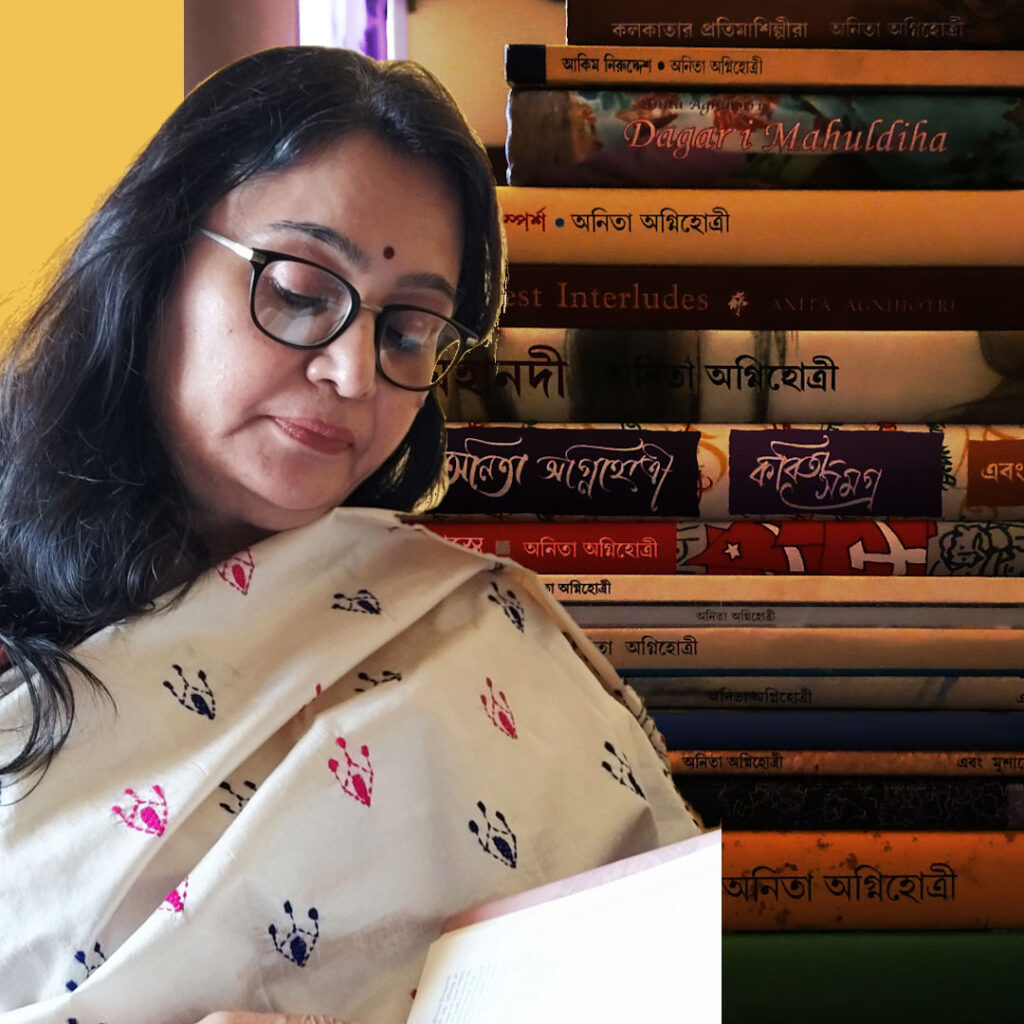
Anita Agnihotri is a Bengali writer. She has been writing poetry, short stories, novels and essays over four decades. Her works have been translated into several major Indian and foreign languages, including English, Swedish, German, Odia and Hindi. She is also a retired civil servant.
Owshnik Ghosh: How were your initial days as a reader of literature?
Anita Agnihotri: My reading of literature essentially started even before I could read and write. Though technically, it was not reading but listening to literature. We lived in a middle-class neighbourhood in Calcutta, and my two brothers were older than I. So, my parents realised that whatever they read, I couldn’t as I had not begun reading. They took the initiative of selecting books and reading them out to us. For instance, my father would read out to us long poems of Rabindranath Tagore, and my mother used to read out when she could find time between cooking and doing the household work. The first book, I recall, that was read out to the three of us over a span of three days was Holde Pakhir Palok by Leela Majumdar. It was a beautiful book. My memories of that and the impact the book created on me are still vivid. The book and the illustrations – everything together was like a dream world. And, since then, as a child, I had thought that my dream would be to write– to be able to write a book like that. And, subsequently, I picked up reading myself. There was no dearth of books at home. My father also used to get me books from the library, and my brothers used to get books from their school library. I had not started going to school, but I had started reading a lot. By the time I went to school, I was surprised at the school admission test, as I felt that the questions were too simple. By this time I was reading Niruddesh Jatra by Rabindranath at home. So, what was given to me to write or to speak in the school test was absolutely, abysmally, easy for me. All that reading did me a lot of good, and I started reading Bankim Chandra Chattopadhyay when I was around eleven and Rabindranath’s short stories, of course, much earlier–because these books were accessible to me. For some reason, my mother used to keep the third volume of Golpoguccho in a drawer that was very tight and very difficult to open. But the other two volumes were within my reach, and I read them. Bibhutibhushan Bandopadhyay was also one of my early readings in the sense that both Pather Panchali and Aparajito were brought by my brother from his school library, and I read them. So, it was a hearty banquet of good literature that I started my childhood with.
OG: Before you started writing prose, you wrote poems, but with time, the number of your poetry books reduced— why so?
AA: Well, I started composing poems very early, even before I could write. So, I used to read out poems and I used to compose songs on my own. And, when I was less than five, my father took noted down a poem that I had recited at home and sent it to the magazine Sandesh. Subhash Mukhopadhyay was the editor of Sandesh along with Satyajit Ray, and he wrote a very beautiful letter in a postcard, saying that the poem is very good for a child of five, but ‘we can’t publish it because she is not a subscriber to Sandesh. But I am sure she will grow up to be a writer.’ My mother had preserved the postcard for a long time. So, my writing poetry continued throughout my childhood. When I was twelve, my first poem in Sandesh came out. I do not know why I am classified in Bengali as a “Ashir dosoker kobi” (laughs)— a poet of the 1980s, because all through the 1970s, I kept writing poetry. In fact, I began writing prose much later — in the early 1980s, and along with prose, I used to write poetry. But, here two problems arose in Bengali writing— one is that people try to put you into a mould— like there is a classification— the moment I am known as an able prose writer, demands for writing stories and novels went up. So, somebody will come and tell you that you have to write poetry. Some people can just write poetry on their own, but I had a very different kind of life. First of all, I was in the Civil Service, where I was travelling frequently. I was busy with work, literally eleven to twelve hours a day, leaving little time on the weekends. So, I think editors play a very important role in the life of a writer, and for me, distance and being away from the Bengali language milieu impacted my writing. So, from the early 2000s, there were editors who would ask me to contribute a story, for example, or a prose piece—if I couldn’t, then they would settle for one poem. In Bengali, we have a word abhimaan– so, in abhimaan, poetry started standing ‘behind the door’, you can say. But, then again, it’s not too bad – I have seven volumes of poetry. I even have a Sreshtho Kobita. So, I don’t think one should write just because one has to bring out books. That concept does not apply to me. But yes, I thought if more sensitive editors were near me, maybe I could have done more experimentation with poetry. Even now, people keep asking for poems. Last year, during the Sarad Sankha, I wrote about twenty poems – that’s a lot by my standard because in a way, in a year, I don’t write more than ten to fifteen poems. It’s a very exclusive avenue of expression for me. I have no regrets about having written less poetry. Poetry has to be understood and thought about at leisure.
OG: Your novels and stories are always windows to the rest of India, especially in the case of Odisha and Maharashtra, for your readers. When did you think that you would choose the rest of India or your workplace as a base for your writing rather than the place where you grew up?
AA: I won’t say that it is the place that is important in writing. First of all, I have a large number of stories woven around Calcutta or Bengal. My novels too – most of my novels are set around Calcutta, from Jara Bhalobeshechhilo to Akal Bodhon, Aleek Jibon. Moholdiyar din is of course placed outside. So, two things happened. One is when I was leaving Bengal and I was joining the Civil Service—that is the time my prose writing was developing. So, there was a huge world that was opening up before me, and I was not like a typical sentimental Bengali who would always regret what had not happened in her life. That was one way of spending life that— “Oh God! You know I am being banished from Bengal. What do I do now?” So, I made the most of whatever I had. I tried to understand other languages, other Indian languages; I tried to understand people belonging to other places. What interests me most is people—their lives, their views of life, the way they look at the world and I would say that it is a different geography—secondary—I mean, if you look at India today, you see that now we have political states otherwise, when you think of the ancient land, how do you even draw a line between what is Madhya Pradesh today and what is Maharashtra, what is Bastar—all was one piece of land! Bengal, Bihar, and Orissa were one place—geographically. The Chhotanagpur has extended into Bankura, Jangalmahal, and Purulia—very familiar! So, for me, this is important, and the quest for Indianness in writing was always a part of my being. Today, if you look at a typical story of Bibhutibhushan Bandopadhyay, like Puimacha—it is not a Bengali story, it is an Indian story. When your expression is so universal that it could be understood by a person speaking any language in any part of the world, then you achieve that quality of universality. If not ‘universal’, I have tried to achieve what is called the ‘core’—the core of Indianness in variety.
OG: What was the story behind writing your epic novel, Mahanadi?
AA: There was no ‘story’ really. I have been thinking of the river—you know, I have been thinking of writing a novel on the Mahanadi and the people around it for a long time. In fact, the river is striking. It is so beautiful, so magnificent—and it is so varied in its journey. It is a long river—it has passed through hills, it had passed through forests, it has passed through gorges and come to the plains—and when it has entered Odisha from Chattisgarh, a huge dam wasbuilt on Mahanadi at Hirakud, which has led to the displacement of several lakhs of people from the river’s hinterland. So, I was not sure. First of all, I will be writing in Bengali. Then, it is about a river that people of Bengal might not have seen properly. Secondly, the format in which I will be writing is different from that of a typical novel. So, I was not very sure about how it would turn out. Yet, I started writing. In fact, I wrote the later part of the novel first. It came out much earlier in Pratidin. Then, I wrote the middle and other parts later. Because I realised the story doesn’t have to develop from one end of the place to the other. It was like a moving circle, going over places. So, I used that format, and the more I wrote, became more and more confident. And finally, in early 2015, the manuscript was complete, and it was published the same year. But it was a great journey for me.
OG: Why did you decide to write a sequel to Mahanadi?
AA: Writing a sequel to Mahanadi was not originally in my plan. But it was suggested by Subhankar Dey, the publisher of Mahanadi, and I thought of a long narrative which will be a journey from the other side— following the course of Indravati river from foot foothills of Niyamgiri in Kalahandi to Gadchiroli, crossing Bastar. The narrative captures the harsh reality of a historical forest region where tribal land and livelihood became the target of the state and the industry, and bloodshed silenced an entire generation of the children of the soil.
OG: Internal migration has played an important role in your writings. Though being one of the major issues in modern times, it is not a topic that is often written about. How do you look into this matter?
AA: I think that is because I have always been a migrant myself. Last year, I wrote an article, Nibondho in Desh— I don’t know whether you have seen it. “Karuno shure baje chiro porobashogiti.”— it is basically saying that you are an outsider, you are a migrant, wherever you are. Even if you may not feel it. Like, my parents had come in the pre-independence times, from what later was East Bengal, and luckily my father could get a foothold in the form of a job in a Government office before the country actually got partitioned in 1947. So, my grandfather, grandmother, and other brothers and sisters who came later when Partition happened and they lost all their property, their house, they had a place to stay in Calcutta. Otherwise, they would have all started life in a refugee camp. So, my mother used to always tell me—even as a child, while feeding me, she used to say, “ Remember this is not our country. Our country has remained there.” So, I grew up in Calcutta feeling like an outsider. And, when I was growing up, I would always listen—“For you people who came from East Bengal-the refugees, our city is so crowded, we have lost so much place for you, so much space for you”—so, that I carried this feeling within me. When I finally studied in Calcutta, at the University of Calcutta, Presidency College, and then got into IAS and the call came to me for choosing a place—so, of course, I chose West Bengal. But in those days, cadre strength in the IAS was much less. I was third in the merit list from West Bengal, but then, only two people got into the West Bengal cadre. I did not make it. But then, I had always been a very strong person in ‘that’ sense—I don’t look at the past. My parents were very upset. The only girl in the family—she’s going out, choosing a career outside Bengal. It was not easy for them. But I took it as a challenge, and I not only loved my work but also loved the people with whom I worked, and I loved the landscapes. And my writing brought out everything. So, I have been migrating again from Bihar-Chhotanagpur, where I worked. After marriage, we decided to go to a state where we could stay together, and my husband. So, I went to Odisha. Then, interestingly, after a few years, I started working as a Director of Rehabilitation, managing the rehabilitation of people who got evicted by the dam projects, irrigation projects, and large water projects. Hirakud was one of them. Hirakud was already done by then, but there were other projects where people were constantly moving. So, all my life I have seen this constant movement of people from one place to the other. And, this creates in you two kinds of feelings. One is a feeling of rootlessness, and secondly, the lack of confidence that rooted people have, and at the same time, you realise that you are not alone. You are a part of a large community who have to keep moving in order to survive. Even today, In India, there are ten to fifteen crore people who are nomads and semi-nomads. They keep moving throughout the year for different livelihoods. If today, you compare my writings with, let us say, that of Jeyamohan and Perumal Murugan, they are rooted in one place. Even Malayalam writing. The writers are so rooted in their society that you can immediately sense the difference. Both Jeyamohan and Perumal Murugan are my favourite writers who have been translated from Tamil to English. Though Perumal Murugan has many other issues, like issues of caste, which have prompted him to write, they are both rooted in the society which they call their own. I have no place. I don’t belong to West Bengal in the sense that I own any land here. I don’t own anything there. So, I have been an eternal traveller. At the same time, Bengali is my language. So, my writing is in Bengali. I am more like a tree that has roots in the soil but whose branches are in the sky.
OG: Besides migration, anthropology has also played an important role in your novels, especially at times when the land becomes a character in itself. What are your thoughts on this?
AA: I have not studied anything other than Economics and Mathematics as a student. But I have picked up a lot of things developing ‘inside’— by looking at people in totality. Their land, the livelihoods, the kind of festivals they have, the way they sing, the way they relate to the forest — all these have seeped into my mind. I would say that, as a person who observes with empathy, I have evolved into a writer. These things may be interpreted differently— you may call them anthropological observations, or you may call them something else. But these are the essential characteristic elements of my writing.
OG: How do you maintain a balance between yourself as an administrator and as a writer?
AA: There is nothing to balance. Even when I joined as a civil servant (I was twenty-four), I had already been writing for one decade. I have always been a writer. But I have never looked at myself as an ‘administrator’. I took on the Civil Service as a career option in the early 1980s. You must understand that pre-liberalisation India was very different. We went purely with a great interest in doing service to the people. And, Civil Service was one job where you can work in different sectors with a lot of interest in policy-making, policy-formulation, and policy-implementation. No other job can give that kind of opportunity. So, we never thought of ‘power’— that we will have an SUV with a blue light, gun-toting policemen will be accompanying us. This concept was not there at all. We have moved virtually alone in villages, in dense forests, and walked for several kilometers through villages. We have never seen this work as an expression of power. That way, the ‘administrator’ part of myself never stood in the way of me as a writer. But one thing has happened, I expressed that very clearly when I wrote Mahuldiha Days. Those who call it the story of an IAS Officer don’t understand it. It is the story of a person in conflict between the state and the people. The state thinks I have given her the responsibility. She will go and convey our words to people. Whereas, when you go to the people, you think of carrying back their words. In this process, a lot of ambivalent thinking is created in your mind. And, that self-doubt is very important for any creativity, for any profession—I would say. A person who is confident, who thinks they have nothing to learn— a person who thinks he/she has total grip over situations; such a person is dangerous to society. Lack of confidence is an element that purifies your thoughts and actions. This is what I have tried to achieve, and this is what has automatically happened. I could never make out which side I belonged to. Though I was a very efficient, honest, and hard-working officer, I have felt that the Government was actually not very confident in what I would actually do when I speak, when I write. And when I come to the people, they try to own me up, they try to embrace me inside their households. But, they know that that is not the ‘end’. I have to go back to where I work. So, this process has helped me every day, basically chiselled me as a writer, sharpening my observations while giving me a lot of pain.
OG: What brought you to the topic of salt-workers?
AA: Salt-farmers. It was not exactly a ‘topic’. Essentially, when I went to Gujarat, I went to see the Statue of Unity. And, since Rann, the Little Rann of Kutch, was not far away, I went there as well. And then I saw this vast desert and the condition of the people there. The Agarias who work there stay in the desert for eight months, without any permanent structure. You know, it is a sanctuary, so you cannot ‘build’— you cannot even provide a structure for storing drinking water. All the water is carried by tankers. Children don’t go to school because they can’t build a structure. Why on earth should a huge place like that be developed as a sanctuary without consulting the people? It is a sanctuary for the preservation of the wild ass. The number of wild asses there could easily co-exist with human beings. The local people are not going to hunt the wild ass. They are very friendly towards them. Our country is still following the British— forests are notified without any consultation from the people who have been staying in the area for generations. And, it is not a ‘forest’ as such. There are only some wild shrubs. No ‘forest’ landscape. But, anyway, it has been done. When I saw that, I was thinking of writing something on them. But then, on the last day of my journey, I went to Sabarmati Ashram. I saw the Ashram and I saw the route of Gandhiji’s march to Dandi. I realised, oh! Gandhiji also worked for salt. He worked for the salt makers for the consumers of salt. His demand was to reduce the excise duty on salt. Why don’t I write a story where the past and the present can be woven together? Lobonakto is a very short novel, with about thirty thousand words. But here I have a character called Tribhuvan, who is an Agaria, a salt-maker. He actually accompanies Gandhiji in the journey. That was an innovation I did, and that changed the whole story. As an Agarian, he saw Gandhi from close quarters. He realised that this travel is not for them, but for the consumers. At the same time, he became a part of the journey, and during the Dharasana raid, he was brutally assaulted. By that time, Gandhi was already jailed in Pune. The Dharasana raid was planned by Gandhi. Dharasana was another salt heap. So, the Satyagrahis tried to capture that, and they were beaten black and blue by the British police. He became a part of that. The story ends with his grandson’s life, Azad, who tries to resist the big corporate interest in the Rann that was trying to destroy their land. When he does that, he is captured by the police. Under a particular National Act, he is removed from his locality. No one knows that. Ultimately, the story ends at the point where the current corporate civilisation has taken over the legacy of Gandhi. This is what Lobonakto is about.
OG: You were engaged with the Narmada Bachao movement from its early days. How was the journey from that time to the formation of your novel, Plaban Jal?
AA: I have said earlier that I was responsible for the rehabilitation and livelihood of the displaced by water resources projects in the mid-1990s when I served as the first Director of Rehabilitation of the Government of Odisha. The Narmada Bachao Andolan was in full force then, and difficult issues relating to rehabilitation were coming up in the Narmada catchment area of Gujarat, Maharashtra, and Madhya Pradesh. When the Sardar Sarovar Dam was dedicated to the nation and the full height of the water level was achieved, the scenario changed in the submerged area. I again travelled in the Narmada catchment area from Amarkantak to Bharuch for around one and a half years as a prelude to writing Plabon Jol. It speaks about the adversity caused by “development” and the valiant non-violent resistance put up by common people along the way. Submergence area, the farmers, the Bhil tribal leaders, and the women.
OG: According to you, what should be the social responsibility of a writer?
AA: I feel that more than social responsibility, the writer has to remain connected with whatever is happening around her, in the society, politically, economically, and to the changes that are happening in the frame of governance. The writer can’t do much, but can be a truthful chronicler of the present. At the same time, if the writer wants to write historical truths, the writer must know how to interpret history. I won’t call it ‘activism’, but one needs to be ‘aware’. You can’t sit at one point and keep on writing. I don’t believe in that kind of writing. But again, I refuse to accept that you have to do research for writing. I don’t believe in ‘kshetrasamikhha’ or research for writing. You cannot do research unless you are interested in your writing. Wherever I feel that there’s something that moves me, interests me, I go. I see. But, eighty percent of it remains unwritten. Whatever ten or fifteen percent finds expression through words is written. It is for me. It is not for any writing that I do. I feel that, every day, if I am not interested in what my fellow people are doing in this country, or in at least some parts of the country where I can go, my life is not complete. As a sensitive human being, if I have to stay in Kolkata, or in any metro city, for twenty days a month, I feel suffocated. Not that the city doesn’t have places of interest. It has, but I prefer another kind of ‘interest’. Like, Kolkata Pratima shilpira is a study of the city.
OG: How possible or rather difficult is it for a writer born and brought up in a metropolitan city to familiarize oneself with people from the so-called ‘periphery’ and write about them?
AA: There’s no ‘difficulty’. People are doing many more difficult things in their lives. Like I said earlier. If you are interested. Does it interest you? One very important writer of my previous generation told me that, “I write about those whom I know.” But that will only include people of the urban society, who have a certain lifestyle. Now, my interest is in understanding what is happening in the country. My interest is in people. I look at people, not as a matter of interest or as a tourist. I deeply believe in their involvement in whatever is going on in their everyday. I learn from them. So, it is not difficult. People are going to Antarctica. People are going to Leh and Ladakh.
OG: Will you call your writing process- a process of getting to ‘understand’ people better?
AA: I would rather say that what interests me is understanding people, and when I go there in the process, I might come back with a story or two.
OS: How difficult is it for a woman to become a writer in this century, despite all that we talk of feminism and women’s empowerment?
AA: It is not ‘difficult’ to be a writer. Fortunately, we have editors and publishers who do not distinguish between male and female writers. If you think that your end objective is to get some recognition, which comes by way of awards or honour, then I would say that it’s not a gender issue. Good writing, as of yet, doesn’t have a level playing field. Good books don’t always reach the people who judge literature. The people who have different kinds of opinions about writing classify writing in watertight compartments. Some people claim to be opinion-makers on social media.
OG: What is the definition of Desh for you, and where do you locate Bharat-varsha on the map?
AA: Desh obviously does not constitute any ‘boundary’ as such for me, nor the political divisions that have happened within this country. I feel that it is a multiplicity of voices, multiplicity of expressions, and a very diverse kind of living, which have come together to represent some kind of oneness, which again, is very difficult to fathom and interpret. That way, my understanding of Desh is what the Gora of Rabindranath had spoken about. It is not a map. It is the people and the people with whom I bond.
OG: What are your views on contemporary Bengali literature?
AA: I am glad to be in Bengal and writing in Bengali when many experiments are on in types and forms of writing. There are serious little magazines, new publishers, and women emerging as Designers and Publishers. However, the readership of serious literature is not expanding adequately, and Bengali language as a medium of instruction and learning is marginalised by the influence of English, Hindi, poor teaching in schools, and attention levels falling with the use of smartphones. Unless the market share of good literature grows, writing does not become a sustainable livelihood.
Also, read Today I Saw Some People from the Visitor’s Gallery by Vandana Yadav, translated from Hindi by Shivani Yadav, and published in The Antonym.
Today I Saw Some People from the Visitor’s Gallery — Vandana Yadav
Follow The Antonym’s Facebook page and Instagram account for more content and exciting updates.