BY NISHI PULUGURTHA
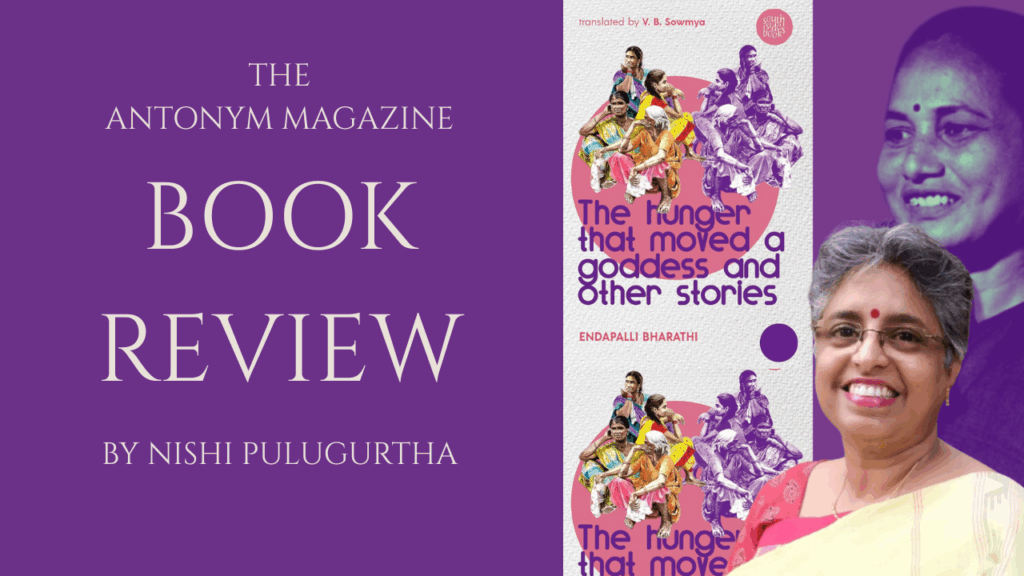
The Hunger That Moved A Goddess and Other Stories by Endapalli Bharathi
Translated by V.B. Sowmya
SouthSide Books, Hyderabad, 2025
It is interesting to see an increasing interest in translation in India. Given the multilingual nature of India, translation is an important tool that enables one to read literature written in various parts of the country. The several networks that translation create is also an interesting phenomenon. A social media post about a new translation is the reason this reviewer picked up the slim volume of translated short stories under review – The Hunger That Moved A Goddess and Other Stories is a volume of 28 Telugu stories translated into English. The volume has an interview with the author, Endapalli Bharathi, where Bharathi speaks of her background and her writing. When asked about how she manages to find time to write amid all her work, Bharathi notes – “At work, I talk with people – stories stem from these chats . . . .We somehow find time to shop for the ingredients, cook and eat. Writing is also like that. I create time amidst my tasks, whether during the day or night, to write.”
Endapalli Bharathi is known for her collections of short stories, Edaari Batukulu (2019) and Bathukeetha (2021) apart from her other works. She is a farmer and her stories speak of the lives of Madiga women in the Chittor district of Andhra Pradesh. Bharathi has also directed short films and edits a Telugu magazine. In the interview in the volume under review, she notes of the language in which she writes – “I write in my spoken tongue, not published print Telugu, about life’s quirks and about moments that stand out from the routine.” V. B. Sowmya’s translation brings out these stories to life in English. In her translator’s Note, Sowmya speaks of an issue that several translators face when they translate from Indian languages into English –“the specific dialect” – that the stories are written in – “Translating a dialect from one language to another is not straightforward, and there is no direct mapping between one dialect in a language and another . . .”. The stories in this volume belong to the two short story collections of Bharathi referred to earlier.
“We Vote for Mallanna!,” the first story in the translation begins in a matter of fact way. We find ourselves in a rural community of women who gather to talk and begin to talk at the violence that they face at the hands of their husbands.
One day, five of us took our cows to the pond, letting them graze on the fragrant green grass floating in the water. I have a brown cow that’s always desperate fro grass. The moment it sees green grass, it charges, dragging the rope – and me along with it – straight from the field. It does not stop until its mouth is inside the grass.
As each of the women begin to recount their stories they find it difficult to decide on which of their husband’s is good – “All of us women decided to vote for Mallanna as the best man of the village. By that time, the cows had fed themselves well and began crying for attention. We ended our chat and took them home.” The simple world of these women, their problems, their looking for a sense of community among kindred kind is beautifully depicted in the story.
Some of the stories in the collection are very small ones. “The Hunger That Moved A Goddess” is one such story. It is a story of a woman who is not given enough food to eat in her marital home and contains a story within a story. The protagonists in the stories are chiefly women, their struggles and daily routines forming the crux of the stories.
Once, two street performers in odd costumes came to our village with four small children. Everyone watched their performance and gave them money but offered no food. They walked from street to street, pleading for a meal. No one bothered to respond, but my vadina called them in, made sangati and gojju, . . .
While the volume has a glossary given right at the beginning that only mentions the terms of kinships and relations, all other Telugu words are left untranslated in the stories. They are not italicized as well. In some cases there is an explanation within the story and in many they are retained. For instance, in the above quotation, the words ‘sangati’ and ‘gojju’ are retained. Sowmya writes of this in her Translator’s Note – “. . . I finally decided to avoid footnotes and use in-text explanations where needed, and add a list of kinship terms as a separate glossary, as they recur throughout the book, and there are no clear English equivalents.”
The title of each story is followed by the Telugu title written in Telugu script and there are black and white illustrations throughout the book. Each story, in fact, has one illustration. “Robust Pasts, Fragile Futures, ” for instance is a story about Seethalu Peddamma – “tall and muscular” is how she is described right at the beginning of the story. There are several other descriptions used to highlight her strength and most of these have to do with farming and agriculture – “She should’ve been a man – God made her a woman by mistake by mistake,” villagers said, awed by her strength and beauty. The illustration for this story has a woman holding a basket on her head while grazing a cow with the rope held in her other hand.
The Hunger That Moved A Goddess and Other Stories takes us to a world of stories, of conversations, to lives of simple women who try to make the most of what they find themselves in. Their lives, struggles and simple joys are what the translations by V.B. Sowmya bring to life. Sowmya, a software engineer, based in Canada, has been translating from Telugu to English and from English into Telugu as well. This slim volume of short stories is a wonderful addition to the corpus of translations from Indian literature that we have been seeing in recent times.
Also, read a book review of “Samskara” by U.R. Ananthamurthy available on The Antonym.
Also, read a book review of “Sakina’s Kiss” by Vivek Shanbag available on The Antonym.
A Satire with a Lightness of Touch— A review of Vivek Shanbag’s Sakina’s Kiss
The Good, The Bad and The Holy— A Book Review of “Samskara” by U. R. Ananthamurthy