BOOK REVIEW BY FALAKNAZ MALEK
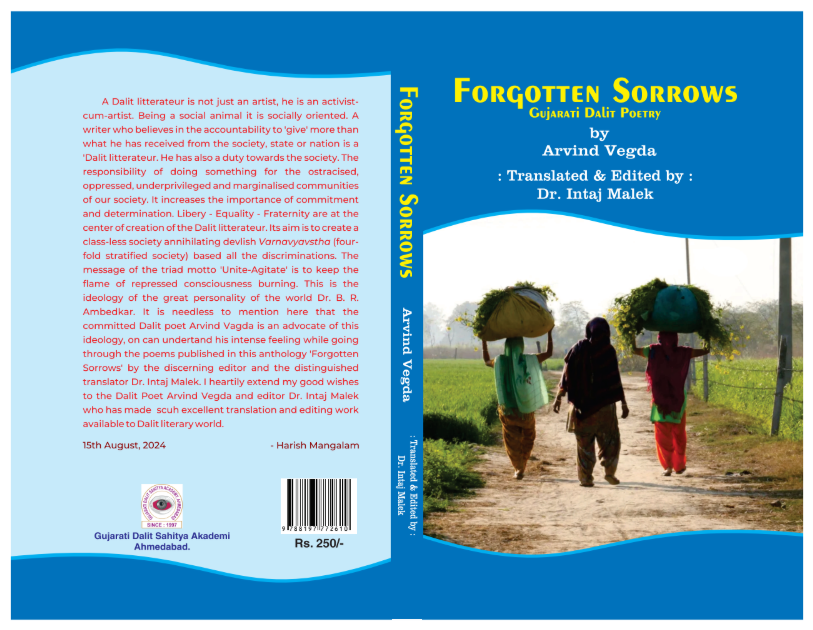
In the shadowed spaces of human experience, where the burden of societal inequities weighs most heavily, Arvind Vegda’s Forgotten Sorrows stands as a luminous testament to the resilience, anguish, and unyielding dignity of the marginalized. Translated from Gujarati into English by Intaj Malek, this anthology draws from Vegda’s three seminal collections- Zebra Crossing, Chaitya Bhumi, and Pageru. It weaves a tapestry of Dalit poetry that is both harrowing and hopeful, a visceral, transcendent call for justice and social awakening.
Vegda’s poems go beyond mere verse; they map the human condition, charting despair, resistance, and hope. Deeply rooted in the Dalit experience, their resonance is universal, capturing the struggle for identity and dignity. Each poem strikes against the edifice of societal norms, carving space for silenced voices long buried under privilege.
The anthology opens with “Agony of Shadow,” setting the tone with its metaphorical portrayal of shadows as burdens borne by the oppressed. These shadows, formless yet omnipresent, symbolize caste oppression—an invisible force stifling the aspirations of the marginalized. This imagery recurs in “Shadow,” where societal prejudices render shadows impure, shrinking only under the gaze of resistance.
In “Steer the Helm, My Friend,” Vegda uses nautical metaphors to depict life as a turbulent voyage. The exhortation to “steer the helm” becomes a call to resilience amid chaos. Similarly, “Zebra Crossing” turns an everyday act into a metaphor for the struggle to reach safety in a hostile world. Rich with evocative imagery, Vegda transforms the mundane into the mythic.
At its core, Forgotten Sorrows interrogates identity and existence. In “A Song of Confusion,” Vegda reflects on the paradox of human connection and the meaning of suffering in a divided world. This introspective tone invites readers to question the arbitrary boundaries between individuals and communities. In “Quest,” the narrator chisels into the “vast void of existence,” only to be pierced by the venom of identity. The resulting “broken, fragmented, headless statue” is a haunting image of a self shattered by societal constructs. Yet, the search for “the elusive essence of humanity” continues—a hopeful gesture amidst despair. This tension between fragmentation and wholeness threads through the entire collection. The poem “Identity” exposes the inescapable entanglement of self with societal labels, particularly caste. The poet’s struggle to exorcise the word underscores its deep grip. In “My Home,” the theme of displacement dominates, as home becomes a fading memory erased by external forces. These poems highlight the psychological toll of marginalization and question what it means to belong.
Vegda’s work is not just a lament; it is a critique of systems that perpetuate injustice. In “Poison,” ancient scriptures are revealed as hypocritical—preaching equality while embedding the “poison of untouchability.” The image of a serpent coiled in a garden of noble ideals captures this betrayal. “The Script of Fate” extends this critique, challenging the deterministic narratives of heritage and questioning inherited oppression. Caste-based violence is starkly depicted in “Caste-Bound” and “Varnashram.” The former uses imagery of blood and vultures to evoke the brutality of discrimination. The latter’s visceral language demands the dismantling of caste hierarchies. Vegda does not flinch in presenting the pain of casteism, compelling readers to face hard truths. “Do They Belong to Us?” and “Will They Ever Be Ours?” address the duplicity of performative allyship. The overflowing lakes and broken dams symbolize neglected promises, while the “impending doom of the ship” warns of misplaced trust. These poems reflect on the failure of solidarity that is superficial and opportunistic.
Despite the starkness, Forgotten Sorrows celebrates resilience. The tributes to Dr. B.R. Ambedkar in “To Ambedkar” and its alternative version are among the collection’s most moving. They honor him as a beacon of hope and justice. The alternate version underscores the impossibility of fully grasping his vast legacy, casting him as a mythic figure and a continuing source of inspiration. “Chaitya Bhoomi” commemorates the site of Ambedkar’s resting place, evoking its symbolic power for Dalit followers. It is a call for unity and a continuation of his mission. “Shambuk Speaks” draws from mythology to give voice to the oppressed and warns of their rising awareness—a poetic prophecy of revolt and resistance. The revolutionary spirit is most evident in “The Spark” and “Clarion Call.” The former reveals the latent strength within oppressed communities; the latter exhorts Dalits to unite and rise, advocating self-defence and organized action. Vegda’s language here is incendiary, signalling the power of collective consciousness.
Even in his darkest portrayals, Vegda balances despair with hope. “Dusk” captures stagnation and unfulfilled hunger, symbolizing a life under oppression. In contrast, “Antidote” and “Inner Resolve” offer redemption through resilience. The former presents resolve as the cure to hatred, and the latter insists on perseverance as resistance. Light and darkness interplay throughout, as in “Open Your Eyes,” where the poet urges readers to awaken to harsh realities hidden behind illusions. The later poems, “The Sacred Fire” and “To Write the Light,” envision a future brightened by education and awareness. Writing becomes a means of enlightenment and social transformation.
Ultimately, Forgotten Sorrows is a call for societal change. “We Must Fight” and “A Jolt” are overt in their advocacy for resistance. The imagery of “boiling cauldrons” and “blazing wildfires” evokes the revolutionary energy of collective uprising. These poems challenge readers to recognize their role—active or complicit—in sustaining or resisting injustice. Vegda’s critique of religious and cultural dogma culminates in “Halt a Little” and “Let Us…” where blind traditions are interrogated and a reimagined future is urged. The anthology’s closing poems are not just poetic expressions but manifestos, articulating the will to dismantle the structures that deny human dignity.
Forgotten Sorrows is not only a literary work but a moral appeal. It bears witness to trauma while illuminating the path to liberation. Through powerful metaphors, philosophical depth, and emotional candour, Vegda’s voice transcends caste to speak to all who believe in justice, equality, and the enduring strength of the human spirit. In this collection, each poem becomes a sedimented whisper – an archaeological artefact of historical violence—layered with the silt of silence, refusal, and return. The poet does not merely recall caste atrocities but re-inscribes them as palimpsests upon the body of language itself, where syntax ruptures, and rhythm mourns. This is not poetry as ornamentation, but poetry as insurgent historiography.
Also, read Poems by Laura Recanati, translated from Italian by Patrick Williamson, and published in The Antonym.
Follow The Antonym’s Facebook page and Instagram account for more content and exciting updates.