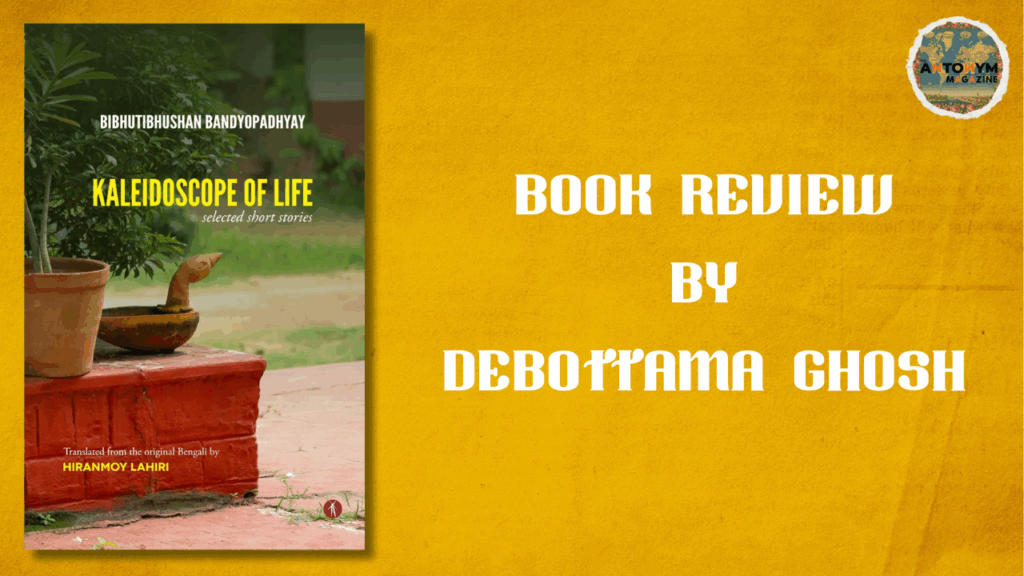
BOOK REVIEW BY DEBOTTAMA GHOSH
In Kaleidoscope of Life– Selected Short Stories of Bibhutibhushan Bandyopadhyay, a newly translated anthology, translator Hiranmoy Lahiri evokes a tapestry of rural Bengal that transcends its historical setting to embrace the elemental and enduring in human experience, which were so profoundly notable in Bandyopadhyay’s writings. The challenge becomes to capture these emotions in translation. Many of the stories in the anthology are grounded in what might be dismissed as mundane. Bandyopadhyay had made the reader feel that in the mundane resides the sublime, Lahiri too in his selection of stories keep this in mind. The translation of the author’s words from the Urmimukhor journal (rendered by Lahiri) underscores this belief:
It is the life of the ordinary people that is often overlooked and ignored, and the best narratives for fiction can be about the ‘daily lives of [ordinary people], their joys and sorrows, their hopes and despairs’. (13)
This reflective meditation sets the emotional and philosophical tone for the entire collection. It captures the spirit of Bandyopadhyay’s oeuvre—his profound attentiveness to fleeting moments, his lyrical rendering of the ordinary, and his quiet celebration of the ignored.
Indeed, the emotional terrain covered by Kaleidoscope of Life is vast. Spanning sixteen stories—thirteen of which are translated for the first time—the volume unfolds the lived intricacies of the pre-Independence social landscape of Bengal. The title itself is aptly chosen, offering a visual metaphor for the shifting hues of sentiment, absurdity, mysticism, and the everyday. Like a kaleidoscope, each story rotates the reader’s perspective, unveiling new patterns in the human experience.
The opening piece, “How I Began Writing,” (Aamar Lekha) does not merely commence the anthology—it opens the doorway to the world of Bandyopadhyay’s intimate creative consciousness, thus becoming an appropriate choice for beginning the anthology. It draws the reader into Bandyopadhya’s oeuvre. In Lahiri’s translation, Bandyopadhyay’s way of writing is explained as:
So many momentous and trivial events take place in the world daily: the cycle of life and death, the aspirations and despairs of people, the moments of joy and sorrow, the ebb and flow of the seasons, the blossoming and wilting of flowers in the forest. Who else but a writer could observe these things and be enchanted by them? (25)
Bandyopadhyay’s strength lies in his rootedness. His prose is steeped in the textures of Bengal’s “mufassil sahors,” those small towns and hinterlands where life thrums in quiet intensity. This is the landscape of Pather Panchali, Aparajito, Aranyak, Ashani Sanket, and Icchamati—works that have been immortalised in translation and cinema. But Kaleidoscope of Life brings us closer to the pulse of these places and their people, not through epic narrative arcs but through gently distilled vignettes.
The anthology’s relevance in contemporary South Asian academia cannot be overstated. As postcolonial studies shift focus towards the microhistories of place and people, the translation of Bandyopadhyay’s work offers valuable insight. Lahiri’s introduction—meticulous and well-researched—acknowledges the layered challenges of translation and traces the lineage and prior appearances of the included stories. He balances academic rigor with affection for the original texts, reminding readers that every author has a distinctive cadence that a translator must honor. In this delicate dance between fidelity and fluidity, Lahiri succeeds, rendering the stories readable and resonant without dulling their emotional charge.
The act of translation—particularly of vernacular literature—is inherently complex. Cultural idioms, inflections, and sensibilities often resist neat equivalence in English. Yet Lahiri’s work in this volume manages to maintain the simplicity and grace of Bandyopadhyay’s narratives. His translations become instruments not just of linguistic conversion but of cultural invocation, contributing to the growing corpus of Indian literature accessible to global audiences. In this, Kaleidoscope of Life becomes a bridge—connecting readers to lives lived in poverty, tradition, spiritual ambiguity, and startling resilience.
Bandyopadhyay’s gift was his ability to absorb. His interactions with diverse communities—Hindus and Muslims, urban dwellers and villagers, sages and tradesmen—enriched his narrative world. His affinity for nature runs through many of the stories, yet war, famine, and civil strife also find quiet entry. He did not write grand histories; instead, he chronicled the tremors that shaped everyday lives. The reason why this translation work gains significance is because it allows a scholar of culture studies to analyze these facets of twentieth-century Bengal.
The anthology’s opening tale, “How I Began Writing” (Aamar Lekha), is semi-autobiographical and offers glimpses into the author’s teaching life and literary genesis. It recounts his inspiration for “The Disregarded” (Upekshita)—a piece born from his time in Rajpur. What follows in the volume often shifts genres: “Archaeology” (Protnotto) and “Not a Story” (Golpo Noi) engage the uncanny and eerie, yet even they map the rural landscapes with vivid intimacy. The eerie and the corporeal world is only used to heighten the sense of intrigue, but what draws the attention of the reader is the way the natural landscape of rural Bengal is detailed with minute authenticity.
Some stories engage the reader with profound sociopolitical undertones. “Discrimination” (Parthokyo) dwells on the Bengal famine’s lingering wounds and the caste-class disparities that magnify suffering. Characters like Khan Sahib emerge with intrigue, their presence layered in ambiguity and humanity. “Chyalaram’s Adventure” (Chyalaram) critiques the narrow experiential range of the Bengali middle class, even as it invites readers to imagine a broader, bolder life beyond domesticity. Bandyopadhyay’s protagonists—rarely wealthy or powerful—are adventurous in spirit and anchored in reality. Their journeys span local histories and global events, from neighbourhood awakenings to world wars.
“Jawaharlal and God” (Jawaharlal O God) veers into satire. It captures the despair and loss that gripped India during Partition and World War II—a time when divine justice seemed absent, and national hope grew faint. Even tales like “The Manifestation” (Abirbhab)—a story ostensibly about an abundant fish catch—unmask deeper societal conditions. There are lines like: “Tell as many poor and needy people as you can…Fish is selling for four rupees a seer these days” (165). The quiet desperation beneath such sentences is palpable. The anguish intensifies with:
It is all very well for you to catch fish my brothers, but don’t forget that cooking oil costs two and a half rupees a seer! If you can’t afford to cook the fish, don’t waste it. Put it back in water. (166)
These words contain multiple layers of suggestions and connotations—the heavy economics of poverty, the absurdity of abundance without access, the bitter irony of hunger amid plenty.
One of the anthology’s more popular tales, “The Suitcase Swap” (Baksho Badol), was adapted into a beloved Bengali film. It narrates the charming serendipity of a mix-up of luggage between two travelers, culminating in unexpected romance. Its simple premise and warm resolution offer a welcome respite amid heavier themes. And in “Theatre Tickets” (Theatrerer Ticket), we witness the slow emergence of modernity. The story reflects a society in transition, where the rising middle class seeks its voice, its leisure, and its legitimacy. It documents not just individuals but a collective moment—when Bengal stood on the cusp of sociocultural transformation.
Taken together, the stories in Kaleidoscope of Life are more than literary artifacts—they are emotional documents of history, identity, and empathy. Bandyopadhyay’s prose, through Lahiri’s attentive translation, reaches across time and language, offering glimpses into lives tenderly observed and truths gently told. This anthology is not only a gift to Bengali readers or scholars of literature—it is a gift to anyone who still believes that stories can heal, illuminate, and endure.
Also, read Poems by Laura Recanati on The Antonym.
Also, read Curved and Other Poems by Guido Cupani on The Antonym.
Follow The Antonym’s Facebook page and Instagram account for more content and exciting updates.